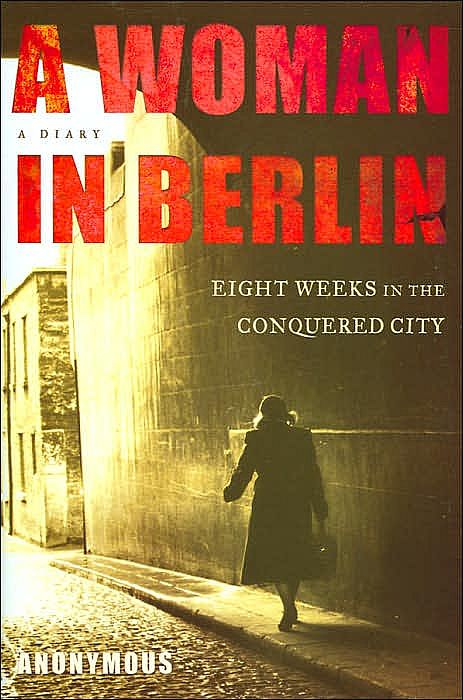
An astonishing find-the landmark journal of a woman living though the Russian occupation of Berlin-which has already earned comparisons to diaries by Etty Hillesum and Victor Klemperer
For six weeks in 1945, as Berlin fell to the Russian army, a young woman, alone in the city, kept a daily record of her and her neighbors' experiences, determined to describe the common lot of millions.
Purged of all self-pity but with laser-sharp observation and bracing humor, the anonymous author conjures up a ravaged apartment building and its little group of residents struggling to get by in the rubble without food, heat, or water. Clear-eyed and unsentimental, she depicts her fellow Berliners in all their humanity as well as their cravenness, corrupted first by hunger and then by the Russians. And with shocking and vivid detail, she tells of the shameful indignities to which women in a conquered city are always subject: the mass rape suffered by all, regardless of age or infirmity. Through this ordeal, she maintains her resilience, decency, and fierce will to come through her city's trial, until normalcy and safety return.
At once an essential record and a work of great literature, A Woman in Berlin not only reveals a true heroine, sure to join other enduring figures of the twentieth century, but also gives voice to the rarely heard victims of war: the women.
The New York Times - Joseph Kanon
The book is graphic and unflinching, with the immediacy of all great diaries (we are always in the present), but what makes it so remarkable is its determination to see beyond the acts themselves. The rapists are not faceless; they have personalities, names (Petka, with the lumberjack hands). They have the contradictions of real people. They are brutal, naïve, even hungry for some kind of connection.
EXCERPT
Friday, 11 pm, by the light of an oil lamp, my notebook on my knees. Around 10 pm there was a series of bombs. The siren started right in screaming. Apparently it has to be worked by hand now. No light. Running downstairs in the dark, we slip and stumble. Finally we're in our cellar, behind an iron door that weighs a hundred pounds. The official term is air-raid shelter. We call it cave, underworld, catacomb of fear.
It's the usual cellar people on the usual cellar chairs, which range from kitchen stools to brocaded armchairs. First is the baker's wife, two plump red cheeks peeking over a lambskin collar. Frau Lehmann whose husband is missing in the east, a pillow-like woman with her sleeping infant on her arm and four-year-old Lutz on her lap, his shoelaces dangling. The young man in gray trousers and horn-rimmed glasses who on closer inspection turns out to be a young woman. Three elderly sisters, dressmakers, huddled together like a big black pudding. The bookselling husband and wife who lived in Paris and often speak French to each other in low voices . . . Then the caretaker's family, consisting of mother, two daughters, and a fatherless grandson. The landlord's housekeeper, who is carrying an aging fox terrier in defiance of all air-raid regulations. And then there's me-a pale-faced blonde always dressed in the same winter coat, which by chance I managed to save, who was employed in a publishing house until it closed last week and sent the employees on leave "until further notice."
RUSSIA AGAINST NAPOLEON
The True Story of the Campaigns of ‘War and Peace’
By Dominic Lieven
War and Peace by Leo Tolstoy is a classic describing the struggle of the Russian people to defeat Napoleon. But was it really the Russian nationalist spirit that made Napoleon to retreat? Neither was it the Russian winter as some French historians say. Dominic Lieven tells us the real reasons in his new book.
Excerpt
(From The New York Times)
‘Russia Against Napoleon’
By DOMINIC LIEVEN
There are usually three stages in the creation of empires, though these stages often overlap. First comes the conquest of empire and the elimination of foreign threats. This is generally a question of military power, diplomatic craftiness, and geopolitical context. To survive, however, an empire needs institutions, otherwise it will disintegrate with the death of the conqueror and his charisma. Establishing these institutions is the second stage in creating an empire and is often harder than the first stage, particularly when huge conquests have occurred in a short period. The third stage requires the consolidation of imperial loyalties and identities in the subject populations, and above all, in the pre-modern world, in their elites.
Napoleon made great progress in the first stage of empire-building, took some steps towards creating imperial institutions but still had a very long way to go in legitimizing his power. To do him justice, he faced a daunting task. A thousand years after the death of Charlemagne, it was rather late in the day to dream of restoring a European empire. Three hundred years after the printing of the vernacular Bible, the imposition of French as a pan-European imperial language was unimaginable. An imperial project backed by a universalist, totalitarian ideology might have gone some way towards establishing empire in Europe for a time. But Napoleon was in no sense a totalitarian ruler, nor was his empire much driven by ideology. On the contrary, he had put the lid on the French Revolution and done his best to banish ideology from French political life. Even the uprooting of local elites in conquered Europe went well beyond Napoleon's desires or his power. In 1812 his empire was still very dependent on his personal charisma.
Many European statesmen understood this and acted accordingly. On the eve of his departure for the Americas in 1809, Count Theodor von der Pahlen, the first Russian minister to the United States, wrote that despite the triumphs of France and its current dominance, within less than fifty years nothing will remain to it but the empty glory of having overthrown and oppressed Europe. It will have acquired no real benefits from this for the French nation, which will find itself exhausted of men and treasure once it can no longer raise them from its neighbours. France's immense current influence depends wholly on the existence of a single individual. His great talents, his astonishing energy and impetuous character will never allow him to put limits on his ambition, so that whether he dies today or in thirty years' time he will leave matters no more consolidated than they are at present.
Meanwhile, added Pahlen, as a new European Thirty Years War continued, the Americas would grow enormously in strength. Of the European powers only the English would be in a position to derive any advantages from this.
The implication of this comment is that in the eyes of history the triumphs and disasters of the Napoleonic era would seem the proverbial tale full of sound and fury, not (let us hope) told by an idiot but also not adding up to much. There is some truth in this. Aspects of the Napoleonic saga were more spectacular than significant. Nevertheless it would be wrong to be too dismissive of the fears and efforts of Europe's statesmen in these years.
Like all political leaders, Russia's rulers had to confront pressing contemporary realities. They could not live on hopes for a distant future. They might well share Theodor Pahlen's longer-term perspectives and believe that, if they could buy time and postpone the conflict with Napoleon, it might actually pass them by. The emperor himself could die or lose his fire. That after all was the rationale behind Nesselrode's spies assiduously reporting whether Napoleon was still eating a good breakfast. Unless fortune intervened, however, Russia's leaders from mid-1810 had to confront the reality that Napoleon was preparing to invade their empire. No doubt if they caved in to his demands war might be averted for a time. But to subscribe to his current version of the Continental System was to undermine the financial and economic bases of Russia's position as an independent power. By definition, this would leave it open to Napoleon to establish a powerful Polish client state which would shut Russia out of Europe.
The chances of Napoleon establishing a lasting empire across Europe may have been poor, though this was far from self-evident in 1812. His regime certainly could put down deep roots west of the Rhine and in northern Italy. It was also well within his power to implement the strategy set out in Champagny's memorandum of 1810, which Russian espionage had acquired for Alexander. There was every reason to fear in 1812 that Napoleon would defeat the Russian army and force peace on Alexander I. This would have resulted in the creation of a powerful Polish satellite kingdom, with its own ambitions in Ukraine and Belorussia. Austria could easily have become the loyal client of Napoleon after 1812, as it became Prussia's first lieutenant after 1866. With its ambitions turned to the Balkans and against Russia, it would have been a useful auxiliary of the French Empire against any threat from the east. Within Germany, a stroke of Napoleon's pen could have abolished Prussia and compensated the King of Saxony for losing his largely theoretical sovereignty over Poland. Meanwhile for at least a generation the combination of French power and regional loyalties would have kept the Confederation of the Rhine (Rheinbund) under Paris's thumb. Russia would be permanently under threat and at the mercy of a Europe organized along these lines. On top of this the consequences of defeat might well include a crushing indemnity and the sacrifices a victorious Napoleon might require Russia to bear in his ongoing war against the British.
Related: Great History Books
Best From PicturesHistory.blogspot.com
Popular Articles On This Site
-
One young officer coming upon a unit that had overtaken a column of German refugees fleeing westward later recalled: ‘Women, mothers an...
-
The Einsatzgruppen were special SS mobile formations tasked with carrying out the mass murder of Jews, communist functionaries, and others...
-
Stalingrad. The word will, perhaps, will always remain synonymous with hardest war. Never was the war so brutal, so inhuman and fought so ...
-
The disaster of Stalingrad profoundly shocked the German people and armed forces alike...Never before in Germany's history had so l...
-
American soldiers and Vietcong fighters came face-to-face only during the fighting, some of it hand-to-hand. No photographer would be a...
-
The Hitlerjugend was Hitler's baby. The young boys who were groomed since the early 1930s did the most ferocious fighting in the war t...
-
War is hell. War is man at his worst. Most bestial. Death. Pain. Violence. When the dogs of war are unleashed.... A dead German so...
-
The Battle Of Stalingrad lasted from July 17, 1942 to February 2, 1943. Two million Germans and Russians died. The entire city was des...
-
This is how the Nazi propaganda machine saw America VIDEO: NAZI PROPAGANDA A nurse from the American Army in France ...
-
Hitler's Nazism is considered wrong on many counts (but there many today, who in private, admire it); the most evident fact is that Naz...
More History Sites
-
Empire of Vikramaditya of Ujjain, Ancient India (Bharatvarsha)
-
Incredible Ancient India (Bharat) : The empire of king Vikramaditya of
Ujjain (Western Data Genesis Gemini AI) - The empire of King Vikramaditya,
histor...
-
DEVI in Aztec Mexico
-
Incredible Ancient India (Bharat Sanatan in Aztec, Mexico)
Maa Durga in the Americas show her revered as Ashtabhuja or Ashtak (Western
Data Genesis Gem...
-
AGNI 6 (World's Fastest Missile)
-
Incredible Innovative India (Bharat Sanatan) : With Agni-6 and BrahMos-2 in
development, the future of Indian deterrence looks unstoppable. Which one
do yo...
"Those who do not remember the past are condemned to repeat it."
-- George Santayana
History Quotes
May 1945 - If hell on earth existed, than it existed in Prague after May the 5th. 1945. Old men, women and children were beaten to death and maimed. Rapes, barbaric cruelties, horror-scenarios of hellish proportions - here they had been let lose.
- Ludek Pachmann, Czech Chess-Grand Master and publicist, forty years after the fact.
Copyright Issue
All the images on this site have been uploaded from the internet. Their copyrights lie with the respective owners.
If inadvertently any copy-righted material is published on this site, the owners of the material may contact us at balri24@gmail.com. We will remove the relevant portion immediately
Quotes
"History is a guide to navigation in perilous times. History is who we are and why we are the way we are."
-- DAVID C. MCCULLOUGH
History, despite its wrenching pain, cannot be unlived, but if faced with courage, need not be lived again.
-- MARY ANGELOU
Quotes
HISTORY, n. An account mostly false, of events mostly unimportant, which are brought about by rulers mostly knaves, and soldiers mostly fools.
-- Ambrose Bierce
We learn from history that we learn nothing from history.
-- GEORGE BERNARD SHAW
Quotes
"I have but one lamp by which my feet are guided, and that is the lamp of experience. I know no way of judging of the future but by the past."
--EDWARD GIBBON
"Patriotism ruins history."
-- GOETHE
Snippets from History
This short but important battle played a key role in the decision to use atomic bombs when attacking Hiroshima and Nagasaki. The battle showed just how far Japanese troops would go to defend their country.
Snippets From History
Paulus didn't give the order to 6th Army to surrender, but his troops no longer had much fight left in them. Resistance faded out over the next two days, with the last die-hards finally calling it quits. One Red Army colonel shouted at a group of prisoners, waving at the ruins all around them: "That's how Berlin is going to look!
"
Quotes
History is Philosophy teaching by examples.
-- THUCYDIDES
Quotes
"Those who cannot learn from history are doomed to repeat it."
-- George Santayana
Points to Ponder: Why Is China Unstable?
The aim of individuals in any society is money and power. Societies that give equal chance to all its members to get them will be the most stable. That is why democracies are more stable than other systems of governance.
China after Deng's reform gave the chance to get rich but power is in the hands of an elite; the Communist Party of China. Membership to the party is at the whims of the local party bosses. This leaves out many people who crave political power dissatisfied and disgruntled. There in lies the roots of instability. The Party suppressed these demands once at Tiananmen in 1989. But force is hardly the way to deal with things like these.
READ MORE: Tiananmen Square Massacre