This site may load slowly at times because of the numerous images. Please reload the page if some of the images do not appear. Thank you.

Search This Site

Russian Imperialism: Soviet Invasion Of Czechoslovakia: 1968

The events in Czechoslovakia in 1968 was a sort of a trailer of what was going to happen to the Soviet Union. But the Soviet tanks rolled in then and the Prague Spring turned into a winter of discontent. But a political tornado blew away all inflexible communist regimes in Warsaw Pact countries twenty years later. A note of caution to China?

WHY THE PRAGUE SPRING CAME ABOUT 

 In the early 1960s, Czechoslovakia, then officially known as the Czechoslovak Socialist Republic (ČSSR), underwent an economic downturn. The Soviet model of industrialization applied poorly to Czechoslovakia. Czechoslovakia was already quite industrialized before World War II and the Soviet model mainly took into account less developed economies. Novotný's attempt at restructuring the economy, the 1965 New Economic Model, spurred increased demand for political reform as well

 Warsaw Pact tank rolls into Prague. 1968

------

In the early 1960s the country suffered an economic recession. Antonin Novotny, the president of Czechoslovakia, was forced to make liberal concessions and in 1965 he introduced a programme of decentralization. The main feature of the new system was that individual companies would have more freedom to decide on prices and wages.

These reforms were slow to make an impact on the Czech economy and in September 1967, Dubcek presented a long list of grievances against the government. The following month there were large demonstrations against Novotny.

In January 1968 the Czechoslovak Party Central Committee passed a vote of no confidence in Antonin Novotny and he was replaced by Dubcek as party secretary. Gustav Husak, a Dubcek supporter, became his deputy. Soon afterwards Dubcek made a speech where he stated: "We shall have to remove everything that strangles artistic and scientific creativeness."

During what became known as the Prague Spring, Dubcek announced a series of reforms. This included the abolition of censorship and the right of citizens to criticize the government. Newspapers began publishing revelations about corruption in high places. This included stories about Novotny and his son. On 22nd March 1968, Novotny resigned as president of Czechoslovakia. He was now replaced by a Dubcek supporter, Ludvik Svoboda.

In April 1968 the Communist Party Central Committee published a detailed attack on Novotny's government. This included its poor record concerning housing, living standards and transport. It also announced a complete change in the role of the party member. It criticized the traditional view of members being forced to provide unconditional obedience to party policy. Instead it declared that each member "has not only the right, but the duty to act according to his conscience."

The new reform programme included the creation of works councils in industry, increased rights for trade unions to bargain on behalf of its members and the right of farmers to form independent co-operatives. 


Source: Spartacus


Soviet troops began entering Czechoslovakia late on August 20th and early August 21st in a carefully orchestrated invasion designed to crush the period of political and economic reforms known as the Prague Spring, reforms led by the country's new First Secretary of the Communist party Alexander Dubcek. A movement viewed by Leonid Brezhnev and other Soviet hard-liners in Moscow as a serious threat to the Soviet Union's hold on the Socialist satellite states, they decided to act. In the first hours on the 21st Soviet planes began to land unexpectedly at Prague's Ruzyne airport, and shortly Soviet tanks would roll through Prague's narrow streets. Within hours foreign troops would take up strategic positions throughout the city, including surrounding the building of the Central Committee of the Communist Party, taking hold of Wenceslas Square, and eventually taking over Czechoslovak radio and television. The occupation of '68 had begun.

Source
VIDEO


"I was sleeping soundly when a friend from New York called me and said 'Have you evacuated the family?' I answered 'Why should I?' and he said 'Prague has been invaded, the airport has been seized, and the Castle is under Russian control..."


American editor Alan Levy was a foreign correspondent in Czechoslovakia in 1968. On August 21st he witnessed some of the first tanks as they steered their way in to the Czech capital.

"I got dressed and went out with my sixteen year-old niece who was staying with us and we didn't see any Russians for a while until in Pohorelec dozen tanks rolled out down the ramp out of Strahov. They were lost. They couldn't find the Castle. They had a tourist map and nothing else. And, they started pointing guns at the crowd and nobody would tell them. When your life almost ends, when a man with his finger on the trigger points it at you is getting ready to shoot - in my case he was ready to shoot at a taxi he thought might be alerting the troops - you're on borrowed time."


It was the most bitter of realisations. For believers in socialism - like Dubcek and other party reformers - it was a betrayal, by partners within the Warsaw pact. Poland, Hungary, East Germany, Bulgaria, the Soviet Union. On the other hand, for long-time opponents to the regime it was final damning proof that at its core Moscow had always been tyrannical - willing to stop at nothing to exercise its will. The Prague Spring, the series of reforms and cultural freedom - including the lifting of censorship, the creation of dialogue, the addressing of past wrongs and new openness in published books and the press - that had been so thoroughly embraced over the last eight months, would prove a short-lived experiment. Socialism with a human face would be stamped out by the presence of more than 200, 000 foreign soldiers, who would triple in number by the end of the week.

VIDEO


 RADIO BROADCAST CUT OFF MID SENTENCE

Meanwhile, on the morning of the 21st, shooting had begun at the Czechoslovak Radio building on Vinohradska Street. After the station broadcast a statement by the Central Committee of the Czechoslovak Communist Party condemning the invasion, Prague citizens gathered at the building to defend the strategic site. Soon, however, broadcasts would be cut off. The last few sentences on the air told Czechs and the rest of the world they had only ever wanted humanistic socialism, adding truth would prevail. Broadcasters were then cut off in mid-sentence as the anthem played, while outside in front of the radio building, several Prague citizens already lay dead.


Kamila Mouckova, a well-known news anchor in Czechoslovakia at that time, knew she had to make her way to Czechoslovak TV, in the city centre, to provide whatever service she could.

"I was very upset. In the morning I drove to a nearby gas-station, and it was there, on the steps of building of the Central Committee of the Communist Party that I saw the first body. It was a young man. To this day I can not describe the feeling in me that this evoked."

At the TV station they broadcast reports throughout the morning of the 21st, while there was still time. Mrs Mouckova says she tried to appeal for calm. After all, could anybody really believe such a sordid state of events would continue? She, for one, did not.

"I tried to get people to pull back, to stay at home, not to go out onto the streets. That it was all just some kind of mistake that events would turn out better in the end."

But, as more and more reports of spontaneous demonstrations and clashes and killing of Czechs emerged, an ever-growing feeling of rage and disbelief began to dominate.

"You know what the primary feeling was? It was terrible - there's no nice way of saying it - I was terribly, terribly angry. I was so furious I was practically foaming at the mouth. I couldn't believe what they had done - the audacity and nerve! The invasion, forcing us out at gunpoint then taking aim at us when they finally uprooted us from our illegal radio broadcast point six days later. By then, it had occurred to each one of us we really might end up lined up against a wall."

VIDEO


The future of their country was not something the Czechs gave up lightly, although there was little hope. They protested in the thousands for days. They clashed, and they pleaded, they hung up placards, and slogans, and wrote graffiti on the walls, crying a common appeal for justice. In their protest, says political scientist Zdenek Zboril, there was simple genius - emotional to observe even thirty-five years after the event.

"I am happy that I could see the spontaneous resistance of the people on the streets, on the posters on the walls. It was unbelievable. It was poetry, jokes, irony - it was an answer to the brutal Soviet invasion. One slogan was typical for this attitude - originally the slogan read 'With the Soviet Union for All Eternity'. But, in that time Czechs came up with the slogan 'With the Soviet Union for Eternity - but not a single day more!"


VIDEO


At the Czechoslovak Radio building, Vinohradská Avenue (Image by Josef Koudelka 1968)
Not another day more but in reality another 21 years of oppression for Czechoslovakia before Czechs and Slovaks would become free. What of the marred lives? Dozens lost during those dark August days, including one student shot at Klarov, in the Little Quarter, for nothing more than wearing a tri-colour pin featuring Czechoslovakia's colours. What of still others who endured the oppressive 'normalisation' period following the fall of Czechoslovakia's reformists? Undesirables, intellectuals, former communists who had erred on the side of reform, who lost their jobs, and were pushed to the fringes. What of their children who were not allowed even to study in university? And, those who were forced to emigrate. Not easy to forget. Even more unforgettable: the sacrifices of Jan Palach and Jan Zajic, who killed themselves in public protest of the regime a year after the invasion - Palach pleading that no other should follow his devastating example, as he lay on his death bed, with third-degree burns on 85 percent of his body. That perhaps was the last enormous symbol of resistance as the period of new oppression set in.

VIDEO


TV anchor Kamila Mouckova: 
 
"Every nation has its history, and everybody should know the history of their own nation. The days of August 1968 are of course key. This is not about cramming facts in school - this is about the challenge for all of us to learn from the event so that it will never again be repeated." 
 
1968 - A year that began with hope and promise for Czechoslovakia and ended in tragedy no one could have foreseen. It changed the direction of a country, and the lives of millions. The last Russian troops finally left Czech soil in 1991.
VIDEO


THE 'PRAGUE SPRING' IN SHORT

In the morning hours of August 21, 1968, the Soviet army invaded Czechoslovakia along with troops from four other Warsaw Pact countries. The occupation was the beginning of the end for the Czechoslovak reform movement known as the Prague Spring. The reform movement had been brewing for years, fed by economic problems as well as growing demands from Communist intellectuals for more freedom and pluralism within a socialist system. But it really gathered steam at the beginning of 1968, in January, when the Communist Party's Central Committee replaced its hard-line First Secretary Antonin Novotny with the moderate reformer Alexander Dubcek, who eventually sided more and more clearly with the forces for change. In March, censorship was loosened and Novotny was relieved of his other function, President of the Republic. He was replaced by a career soldier, Ludvik Svoboda, whose last name in Czech means "freedom"-- a purely linguistic coincidence that countless posters and flyers during the invasion made use of, although Svoboda ultimately sided with opponents of reform.

In the following months, censorship was further loosened , some political prisoners were freed, and topics that until recently had been taboo--such as the politically motivated show trials of the 1950's--began to be openly discussed. The government adopted an "Action Program" that aimed at democratization of the Communist party and pluralism in politics and society. Meanwhile, Communist leaders elsewhere in Central Europe began to express more and more reservations about the reforms; during the spring, Warsaw Pact troops began maneuvers on Czechoslovak territory. Although the Czechoslovak reformers always affirmed their intention of remaining within the bounds of a socialist system led by the Communist party, the reforms eventually began to take on a life of their own.

Source

A Czech woman weeps with a blood-stained flag of her country. Cry for freedom.

THE RESPONSE OF THE REFORMERS

One of the immediate causes of the Soviet invasion, aside from mounting fears that Dubcek could not control popular pressure for change, was the plan to convene a Fourteenth Party Congress in September 1968, whose delegates would elect a solidly pro-reform Central Committee. The invasion changed the schedule, and the Congress was held on August 22nd--over a thousand delegates disguised as workers made it past Soviet troops to convene at a factory in Vysocany outside Prague. It issued proclamations condemning the invasion, supporting the reform process, and threatening a one-hour general strike (document 2A). The strike took place as planned, but power was already shifting out of the reformers' hands.

Hastily worded pamphlets and flyers, often with typos, often mimeographed on cheap paper, spread information about the occupation, calling on Czechoslovaks to resist peacefully and reaffirming popular loyalty to Dubcek and the other reform leaders, who had been interned in the early hours of the invasion and shipped off to Moscow for "negotiations" about the country's future. Newspapers and magazines continued to publish, often with the words "Legal" or "Free" added to the masthead to indicate that they were not in the hands of the occupiers . Radio continued to broadcast from secret transmitters even after the central radio building in Prague had been battered into submission . Flyers printed in Russian were designed to explain the situation to Soviet soldiers, many of whom had little idea of where they were or what they were doing there . Graffiti in Russian was also common


WHAT HAPPENED NEXT?

At the same time, a careful reading of the documents reveals some curiosities. Proclamations and declarations from Communist party organs opposing the invasion employed all the standard jargon of Communist ideology, appealing in characteristically clunky syntax to the international workers' movement and the country's workers - a linguistic affinity underlining the fact that the reforms had, after all, been carried out in a socialist framework. Above all, these materials illustrate a central paradox of the invasion: both occupiers and resisters consistently called for calm, peace, and quiet, echoing Dubcek's and Svoboda's appeals to maintain order. The call for "calm and level-headedness" (klid a rozvaha) was repeated over and over, and the demand for a "normalization" of the tense situation would become a mantra of both sides. Many Czechoslovaks, facing a far superior military force, did not want to provide the occupying forces with a pretext for violent crackdowns; much of the popular resistance to the invasion would be passive and dignified . The invaders themselves wanted to forestall violent opposition . In the aftermath of August 21, both Czechoslovakia's legitimate leaders and the occupiers aimed at the same goal, however differently they understood it: securing the normal functioning of daily life in the country.

The country persisted in this strange state of tentative resistance for months. The reform leaders who had been interned and brought to Moscow for negotiations were more or less forced to sign the so-called Moscow Protocol, which declared the 14th Congress invalid, re-instituted controls over the media, and rolled back the reforms in other ways - all topped off with a promise by the Czechoslovak and Soviet governments to "intensify . . . their fraternal friendship for time everlasting." The only person not to sign the Protocol, Chairman of the National Front Frantisek Kriegel, was subsequently stripped of all his functions and finally expelled from the party in 1969 . Other reform leaders, including Dubcek, were allowed to maintain their functions and even some power, but they tended to discourage public displays of discontent for fear of provoking their Soviet overseers. At the end of March 1969, the Czechoslovak ice hockey team defeated the Soviets, a victory that sparked mass demonstrations throughout the country and finally provided the pretext for a full-scale crackdown . Dubcek was ousted as Party Secretary by the opportunistic, brutally colorless functionary Gustav Husak, who presided over an ever-strengthening purge of the party and society. Protests on August 21, 1969 were brutally suppressed and turned out to be the last mass demonstrations against the invasion, as the country settled down into the gray years of bureaucratic oppression known as "normalization."


'Lenin wake up, Brezhnev has gone mad.'
 This was one of the slogans chanted on the street of Prague 30 years ago as Russian and Warsaw Pact troops invaded Czechoslovakia.


This Czech man is wants to do business, but the Soviet Union stubbornly clung onto communism. In vain.


Vinohradska Street, August 21st, 1968

Prague, August 21st 1968


Wenceslas Square, August 1968

Related: The Soviet Invasion Of Hungary...

Share this PostPin ThisShare on TumblrShare on Google PlusEmail This

How ERWIN ROMMEL Died

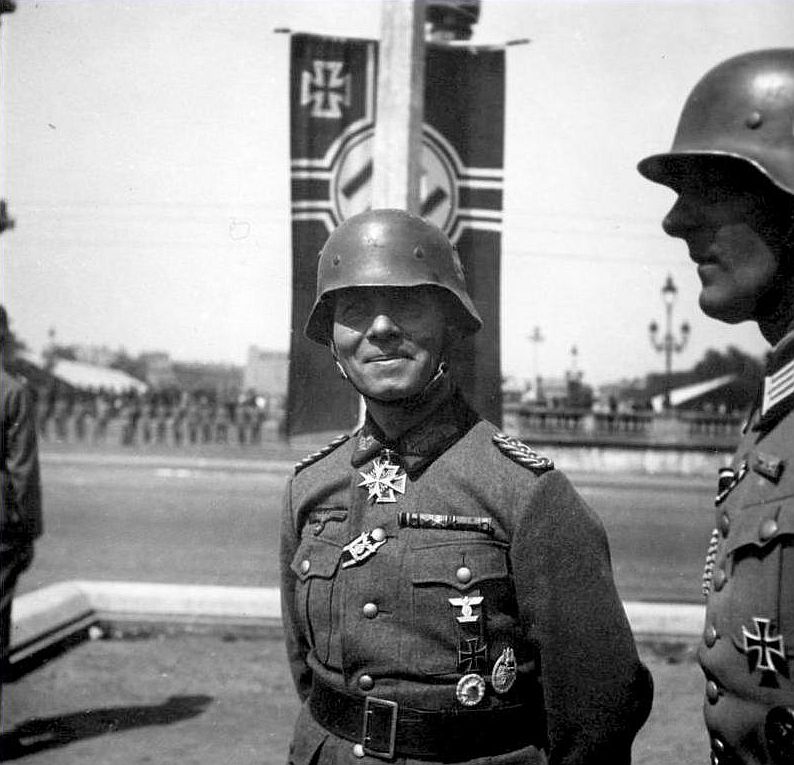
Erwin Rommel. The gentleman general of the Third Reich. An ace soldier of the Wehrmacht but not a Nazi. That ultimately led to his death.


On July 17, 1944, British aircraft strafed Rommel's staff car, severely wounding the Field Marshall. He was taken to a hospital and then to his home in Germany to convalesce. Three days later, an assassin's bomb nearly killed Hitler during a strategy meeting at his headquarters in East Prussia. In the gory reprisals that followed, some suspects implicated Rommel in the plot. Although he may not have been aware of the attempt on Hitler's life, his "defeatist" attitude was enough to warrant Hitler's wrath. The problem for Hitler was how to eliminate Germany's most popular general without revealing to the German people that he had ordered his death. The solution was to force Rommel to commit suicide and announce that his death was due to his wounds.


 Rommel with his son Manfred and wife Lucie

Rommel's son, Manfred, was 15 years old and served as part of an antiaircraft crew near his home. On October 14th, 1944 Manfred was given leave to return to his home where his father continued to convalesce. The family was aware that Rommel was under suspicion and that his chief of staff and his commanding officer had both been executed. Manfred's account begins as he enters his home and finds his father at breakfast:

"...I arrived at Herrlingen at 7:00 a.m. My father was at breakfast. A cup was quickly brought for me and we breakfasted together, afterwards taking a stroll in the garden.

'At twelve o'clock to-day two Generals are coming to discuss my future employment,' my father started the conversation. 'So today will decide what is planned for me; whether a People's Court or a new command in the East.'

'Would you accept such a command,' I asked.
He took me by the arm, and replied: 'My dear boy, our enemy in the East is so terrible that every other consideration has to give way before it. If he succeeds in overrunning Europe, even only temporarily, it will be the end of everything which has made life appear worth living. Of course I would go.'

Shortly before twelve o'clock, my father went to his room on the first floor and changed from the brown civilian jacket which he usually wore over riding-breeches, to his Africa tunic, which was his favorite uniform on account of its open collar.

At about twelve o'clock a dark-green car with a Berlin number stopped in front of our garden gate. The only men in the house apart from my father, were Captain Aldinger [ Rommel's aide] , a badly wounded war-veteran corporal and myself. Two generals - Burgdorf, a powerful florid man, and Maisel, small and slender - alighted from the car and entered the house. They were respectful and courteous and asked my father's permission to speak to him alone. Aldinger and I left the room. 'So they are not going to arrest him,' I thought with relief, as I went upstairs to find myself a book.


A few minutes later I heard my father come upstairs and go into my mother's room. Anxious to know what was afoot, I got up and followed him. He was standing in the middle of the room, his face pale. 'Come outside with me,' he said in a tight voice. We went into my room. 'I have just had to tell your mother,' he began slowly, 'that I shall be dead in a quarter of an hour.' He was calm as he continued: 'To die by the hand of one's own people is hard. But the house is surrounded and Hitler is charging me with high treason. ' "In view of my services in Africa," ' he quoted sarcastically, 'I am to have the chance of dying by poison. The two generals have brought it with them. It's fatal in three seconds. If I accept, none of the usual steps will be taken against my family, that is against you. They will also leave my staff alone.'
'Do you believe it?' I interrupted. 'Yes,' he replied. 'I believe it. It is very much in their interest to see that the affair does not come out into the open. By the way, I have been charged to put you under a promise of the strictest silence. If a single word of this comes out, they will no longer feel themselves bound by the agreement.'

I tried again. 'Can't we defend ourselves…' He cut me off short. 'There's no point,' he said. 'It's better for one to die than for all of us to be killed in a shooting affray. Anyway, we've practically no ammunition.' We briefly took leave of each other. 'Call Aldinger, please,' he said.

Aldinger had meanwhile been engaged in conversation by the General's escort to keep him away from my father. At my call, he came running upstairs. He, too, was struck cold when he heard what was happening. My father now spoke more quickly. He again said how useless it was to attempt to defend ourselves. 'It's all been prepared to the last detail. I'm to be given a state funeral. I have asked that it should take place in Ulm. [a town near Rommel's home] In a quarter of an hour, you, Aldinger, will receive a telephone call from the Wagnerschule reserve hospital in Ulm to say that I've had a brain seizure on the way to a conference.' He looked at his watch. 'I must go, they've only given me ten minutes.' He quickly took leave of us again. Then we went downstairs together.

We helped my father into his leather coat. Suddenly he pulled out his wallet. 'There's still 150 marks in there,' he said. 'Shall I take the money with me?'

'That doesn't matter now, Herr Field Marshal,' said Aldinger.
 Looking after the Atlantic Wall defences on the French coast

My father put his wallet carefully back in his pocket. As he went into the hall, his little dachshund which he had been given as a puppy a few months before in France, jumped up at him with a whine of joy. 'Shut the dog in the study, Manfred,' he said, and waited in the hall with Aldinger while I removed the excited dog and pushed it through the study door. Then we walked out of the house together. The two generals were standing at the garden gate. We walked slowly down the path, the crunch of the gravel sounding unusually loud.

As we approached the generals they raised their right hands in salute. 'Herr Field Marshal,' Burgdorf said shortly and stood aside for my father to pass through the gate. A knot of villagers stood outside the drive…
The car stood ready. The S.S. driver swung the door open and stood to attention. My father pushed his Marshal's baton under his left arm, and with his face calm, gave Aldinger and me his hand once more before getting in the car.

The two generals climbed quickly into their seats and the doors were slammed. My father did not turn again as the car drove quickly off up the hill and disappeared round a bend in the road. When it had gone Aldinger and I turned and walked silently back into the house…

Twenty minutes later the telephone rang. Aldinger lifted the receiver and my father's death was duly reported.

It was not then entirely clear, what had happened to him after he left us. Later we learned that the car had halted a few hundred yards up the hill from our house in an open space at the edge of the wood. Gestapo men, who had appeared in force from Berlin that morning, were watching the area with instructions to shoot my father down and storm the house if he offered resistance. Maisel and the driver got out of the car, leaving my father and Burgdorf inside. When the driver was permitted to return ten minutes or so later, he saw my father sunk forward with his cap off and the marshal's baton fallen from his hand."

"The Forced Suicide of Field Marshall Rommel, 1944," EyeWitness to History, www.eyewitnesstohistory.com (2002).


Born in 1891 in Heidenheim, the son of a schoolmaster, Rommel was a thrifty, loyal and punctual man, with some similarities to Guderian; impatient with authority and capable of driving his men beyond their normal limits. In the First World War he led his man into ferocious fighting at Caporetto in the Italian mountains, and was recommended for the highest Imperial decoration for bravery, pour le Mérite. In the postwar army he became an instructor of tactics, using his experiences and sucesses from the war, and published his lectures as a book: Infanteri Greift An. This bestseller brougth him fame and fortune and the attention of Hitler.

Though never tested against the Russians, or at the highest level of command, the evidence suggests that Rommel was one of Germany's greatest soldiers. Even the Allies felt a rueful admiration for the "Desert Fox", although a great deal of his success stemmed from a highly developed sense of opportunism.

 Rommel with British prisoners in Cherbourg in 1940. He was a gentleman. Allied POW say he ordered that they be fed well and given enough rations as a German soldier would get.

ROMMEL'S AFRICAN CAMPAIGN


Sent to North Africa in January 1941 to the assistance of the stricken Italians, Rommel proceeded to win a reputation as a strategist and theater commander. The "Afrika Korps" consisted of two divisions, the 5th Light Division which arrived at Tripoli on 14 February 1941 and followed in April by the 15th Panzer Division. Acting independently of his superior, Marshal Gariboldi, the Italian Commander-in-Chief, and forbidden by Berlin to take offensive action before the end of May, Rommel directed every unit of the 5th Light eastwards as soon as it landed. On 24 March he had its first combat engagement with the British blocking El Agheila, who abandoned the position. Rommel immediately used the mobility of his division in the best tradition of Blitzkrieg, spliting his forces into three battlegroups to drive along the coast and inland. Flying overhead in his Fieseler Storch, he was able to land frequently beside the heads of the columns to push his officers further.

It was the Panzerwaffe's sword-and-shield combination of tanks, anti-tank guns (especially the 88mm) and tank-destroyers that won many battles, often resulting in the Germans retaining the battlefield and therefor be able to recover damaged vehicles. Meanwhile the Royal Navy and the RAF wreaked such havoc in the sea lanes that the supplies reaching North Africa were insufficient. Through occasionally overbold, Rommel retained the initiative in the fight with the British until the summer of 1942, when the balance of force shifted decisively in the British favor, and even then he made Montgomery pay a high price for his victory at El Alamein. On 8 November 1942, when the British and Americans landed in Algeria and Morocco, the Afrika Korps had about twenty tanks left, and Rommel was forced to retreat through Libya to Tunisia, a distance of 2400 km, fighting only rearguard actions when absolutely necessary.


The Desert Fox in action in Africa

ROMMEL IN NORMANDY


Next sent to France as commander of Army Group B under von Rundstedt in the invasion sector, he worked vigorously to improve the defences of the Channel coast. He and Rundstedt disagreed over the location of the armor for the defensive battle; Rommel, chastened by his defeat in Africa and his experience with Allied airpower, was in favour of defeating the invaders before they could establish themselves ashore. Rundstedt and Guderian expressed the opposite view, that adequate reserves of panzers were to be stationed far enough inland from the Atlantic Wall, so that they could be switched easily to the main invasion front once it had been recognised. After the invasion in Normandy, Hitler continued to believe that the Normandy landings were a feint and that sooner or later the Allies would make their main invasion effort near Calais.

Despite losing the argument, Rommel contained the Allied landings and blunted their early attempts at break-out. On July 17th, however, he was strafed in his staff car by a British fighter and severely wounded. Before he had fully recovered, he fell under suspicion of complicity in the Bomb Plot and was offered by Hitler the choice of disgrace or suicide. He chose the latter, was declared to have died of his wounds and buried with state pomp.


Source


RELATED

Share this PostPin ThisShare on TumblrShare on Google PlusEmail This

German Troops Move Into Prague: Annexation Of Czechoslovakia: 1939

Shortly after he signed the Munich Agreement in September 1938, Adolf Hitler privately complained to members of his SS bodyguard, "That fellow Chamberlain spoiled my entrance into Prague."

Hitler goes to Prague triumphantly. 1939

Hitler originally wanted to smash Czechoslovakia via a lighting military strike and then make a Caesar-like entry into the old capital city. But he had been overwhelmed by the eagerness of Britain and France to serve Czechoslovakia to him "on a plate."

For Hitler, the Munich Agreement was nothing more than a worthless piece of paper. On October 21, 1938, just three weeks after signing the document, he informed his generals that they should begin planning for "the liquidation of the remainder of Czechoslovakia."

Hitler had promised British Prime Minister Neville Chamberlain and the German people that the Sudetenland would be his "last territorial demand" in Europe. In reality, it was only the beginning. And Hitler now wanted to grab the remainder of Czechoslovakia due to its strategic importance.

By now, the Nazis had perfected the art of stealing neighboring territory. They would start by encouraging political unrest inside the area. At the same time, they would wage a propaganda campaign citing real or imagined wrongs committed against local Germans. When neighboring political leaders finally came to see to Hitler to resolve the ongoing crisis, they would be offered help in the form of a German Army occupation to "restore order."

The new political leader of Czechoslovakia was 66-year-old Dr. Emil Hácha, an inexperienced politician with a bad heart condition.

He had replaced Czech President Eduard Bene� who fled to England after the Munich Agreement fearing assassination by the Nazis. Hácha now presided over an ever-shrinking republic. By early 1939, two outlying border areas had already been seized by Poland and Hungary with Hitler's approval.

At Hitler's instruction, nationalist Slovaks living in the eastern portion of Czechoslovakia began agitating for a completely independent state, which would take another huge chunk out of Czechoslovakia. On March 10, 1939, President Hácha responded to the Slovak demand for independence by ousting the leaders of the Slovak government and declaring martial law inside the province of Slovakia.

Hácha's unexpected and defiant action took the Nazis by surprise, upsetting their carefully laid plans. Hitler reacted to this turn of events just as he had when Schuschnigg took a defiant stance in Austria - he ordered his generals to prepare for an immediate invasion.

Meanwhile, the pro-German Slovak leader, Monsignor Tiso, was summoned to Berlin to see Hitler. Tiso arrived at the Chancellery on Monday evening, March 13, and was told by Hitler that the situation in Czechoslovakia had become "impossible." Time was running out said Hitler. Tiso had to decide right then and there whether Slovakia wanted to break off from Czechoslovakia and become an independent country. Hitler promised Tiso that he would protect Slovakia after its independence was proclaimed.


Tiso hesitated briefly then decided to go along with Hitler. The Nazis then drafted a proclamation of independence for Tiso to use, along with a phony telegram to be sent later containing an appeal for the Führer's protection.

The following day, Tuesday, March 14, Tiso returned home and presented the independence proclamation to Slovakia's parliament. He told the assembly that if they failed to approve this proclamation, Hitler's troops would simply march in and take Slovakia. Faced with this prospect, the Slovak assembly gave in and voted with Tiso. Thus the independent country of Slovakia was born.

Now, all that remained of shrunken Czechoslovakia were the two central provinces of Bohemia and Moravia. At this point, Goebbels' propaganda machine went into high gear spreading reports of alleged persecution of local Germans there by Czechs. Out of convenience, or perhaps out of laziness, Goebbels' propaganda people used the same fake newspaper stories they had printed six months earlier concerning the Czech "reign of terror" in the Sudetenland.

President Hácha, bewildered by all that was happening to Czechoslovakia, sent a message to Hitler asking for a face-to-face meeting to resolve the ongoing crisis. Hitler, of course, agreed to see him as soon as possible.

Hácha was unable to fly due to his heart condition and arrived by train in Berlin at 10:40 p.m. on Tuesday evening. He was met by Foreign Minister Ribbentrop and taken to the Aldon Hotel to await Hitler's call.


Nearly three hours later, at 1:15 a.m., Hácha was finally summoned to the Reich Chancellery to see the Führer. At this meeting, Hitler let the Czech president speak first and for as long as he wanted. President Hácha proceeded to humble himself unabashedly in the presence of the all-powerful German dictator. He disavowed any link with the previous democratic government in Czechoslovakia and promised to work toward eliminating any anti-German sentiment among his people. He then pleaded for mercy on behalf of his little country.

But Hácha's pitiful pleading brought out the worst in Hitler, a man who had utter contempt for human weakness. When Hácha finished his monologue, Hitler launched into a blistering attack, citing all of the alleged wrongs committed by Czechs against Germans.

Working himself into a self-induced state of rage, Hitler hollered out that his patience with Czechoslovakia had ended, and that the German Army was about to invade the country, beginning in just a few hours.

Now, the Führer bellowed, the Czech people had two options. They could offer futile resistance and be violently crushed, or, the president could sign a document telling his countrymen to peacefully receive the incoming troops. The president had to decide soon. The troops would march in regardless beginning at 6 a.m. that morning.

President Hácha, taken completely by surprise, was at first too shocked to respond and just sat there as if he had turned to stone. Hitler was done with him for the time being and sent him into an adjoining room for further discussions with Göring and Ribbentrop.


The two Nazis immediately pounced on the sickly president, badgering him into signing the surrender document which was placed on the table before him. But Hácha, after regaining his composure, refused outright. The Nazis insisted again, even pushing a pen at him. He refused again. Now, Göring played his trump card. He told the Czech president that unless he signed, half of Prague would be bombed to ruins within two hours by the German Air Force. Upon hearing this, the frail president collapsed onto the floor.

The Nazis panicked, thinking they had killed the man with fright. Hitler's personal physician, Dr. Theodor Morell, was rushed in and injected the president with vitamins to revive him. When Hácha recovered his senses, the Nazis stuck a telephone in his hands, connecting him with his government back in Prague. Hácha spoke into the telephone and reluctantly advised his government to surrender peacefully to the Nazis.

After this, Hácha was ushered back into Hitler's presence. At 3:55 a.m., Wednesday, March 15, the Czech president signed the document stating he had "confidently placed the fate of the Czech people and country in the hands of the Führer of the German Reich."

Two hours later, amid a late winter snowstorm, the German Army rolled into the first non-Germanic territory to be taken by the Nazis.

"Czechoslovakia has ceased to exist!" Hitler announced to the German people later that day, just before departing for Prague. That evening, Hitler made his long-awaited entry into the grand old city at the head of ten vehicle convoy. But there were no cheering crowds. The streets of Prague were deserted.


Hitler spent the night in Prague's Hradschin Castle, former home to the Kings of Bohemia. The next day, Thursday, March 16, from inside the castle, Hitler issued a proclamation establishing the Protectorate of Bohemia and Moravia. "Czechoslovakia," Hitler declared, "showed its inherent inability to survive and has therefore now fallen victim to actual dissolution."

That same day, Tiso sent his pre-arraigned telegram from Slovakia urgently requesting the Führer's protection. The two-day-old independent country of Slovakia thus ceased to exist as the German Army rolled in, supposedly at the request of the Slovaks themselves.

At this point, the whole world waited to see how Prime Minister Chamberlain would react to the incredible happenings in Czechoslovakia, all of which were gross violations of the Munich Agreement.

Chamberlain responded to Hitler's aggression by claiming the British were not bound to protect Czechoslovakia since the country in effect no longer existed after Slovakia had voted for independence on March 14. And Hitler's actions had occurred the next day, March 15.

The Prime Minister's willy-nilly statement caused an uproar in the British press and in the House of Commons. Chamberlain was lambasted over his lack of moral outrage concerning Hitler's gangster diplomacy. Angry members of the House of Commons vowed that Britain would never again appease Hitler.


Interestingly, while traveling on a train from London to Birmingham on Friday, March 17, Chamberlain underwent a complete change of heart. He had in his hand a prepared speech discussing routine domestic matters that he was supposed to give in Birmingham. But upon deep reflection, he decided to junk the speech and outlined a brand new one concerning Hitler.

In the new speech, which was broadcast throughout England on radio, Chamberlain first apologized for his lukewarm reaction to Hitler's recent actions in Czechoslovakia. Then he recited a list of broken promises made by Hitler dating back to the Munich Agreement.

"The Führer," Chamberlain asserted, "has taken the law into his own hands."

"Now we are told that this seizure of territory has been necessitated by disturbances in Czechoslovakia...If there were disorders, were they not fomented from without?"

"Is this the last attack upon a small state or is it to be followed by others? Is this, in effect, a step in the direction of an attempt to dominate the world by force?"

If so, Chamberlain declared: "No greater mistake could be made than to suppose that because it believes war to be a senseless and cruel thing, this nation has so lost its fiber that it will not take part to the utmost of its power in resisting such a challenge if it ever were made."

Now, for the first time in the history of the Third Reich, Great Britain had finally declared it would stand up to the German dictator and was willing to fight.

The next day, March 18, British diplomats informed the Nazis that Hitler's occupation of Czechoslovakia was "a complete repudiation of the Munich Agreement...devoid of any basis of legality." The French also lodged a strong protest saying they "would not recognize the legality of the German occupation."


However, Hitler and the Nazis could care less what they thought. Hitler had seen his "enemies" at Munich and considered them to be little worms.

But now, in an ominous development for Hitler, Britain and France went beyond mere diplomatic protests. On March 31, Prime Minister Chamberlain issued a solid declaration, with the backing of France, guaranteeing Hitler's next likely victim, Poland, from Nazi aggression.

The era of Hitler's bloodless conquests had ended. The next time German troops rolled into foreign territory there would be an actual shooting war.

Text Source: HistoryPlace


This is how a Russian cartoonist depicted the capitulation at the Munich conference

Share this PostPin ThisShare on TumblrShare on Google PlusEmail This

You Might Like These....

Search This Site

Popular Articles On This Site

More History Sites

Illustrated History

A Lousy Journalist?

A Lousy Journalist?
"Those who do not remember the past are condemned to repeat it."
-- George Santayana


History Quotes

May 1945 - If hell on earth existed, than it existed in Prague after May the 5th. 1945. Old men, women and children were beaten to death and maimed. Rapes, barbaric cruelties, horror-scenarios of hellish proportions - here they had been let lose.

- Ludek Pachmann, Czech Chess-Grand Master and publicist, forty years after the fact.

Copyright Issue

All the images on this site have been uploaded from the internet. Their copyrights lie with the respective owners.

If inadvertently any copy-righted material is published on this site, the owners of the material may contact us at balri24@gmail.com. We will remove the relevant portion immediately

Quotes

"History is a guide to navigation in perilous times. History is who we are and why we are the way we are."
-- DAVID C. MCCULLOUGH

History, despite its wrenching pain, cannot be unlived, but if faced with courage, need not be lived again.
-- MARY ANGELOU

Quotes

HISTORY, n. An account mostly false, of events mostly unimportant, which are brought about by rulers mostly knaves, and soldiers mostly fools.
-- Ambrose Bierce

We learn from history that we learn nothing from history.
-- GEORGE BERNARD SHAW

Quotes

"I have but one lamp by which my feet are guided, and that is the lamp of experience. I know no way of judging of the future but by the past."
--EDWARD GIBBON

"Patriotism ruins history."
-- GOETHE

Snippets from History

This short but important battle played a key role in the decision to use atomic bombs when attacking Hiroshima and Nagasaki. The battle showed just how far Japanese troops would go to defend their country.


Snippets From History

Paulus didn't give the order to 6th Army to surrender, but his troops no longer had much fight left in them. Resistance faded out over the next two days, with the last die-hards finally calling it quits. One Red Army colonel shouted at a group of prisoners, waving at the ruins all around them: "That's how Berlin is going to look!
"


Quotes

History is Philosophy teaching by examples.
-- THUCYDIDES

Quotes

"Those who cannot learn from history are doomed to repeat it."
-- George Santayana

Points to Ponder: Why Is China Unstable?

The aim of individuals in any society is money and power. Societies that give equal chance to all its members to get them will be the most stable. That is why democracies are more stable than other systems of governance.

China after Deng's reform gave the chance to get rich but power is in the hands of an elite; the Communist Party of China. Membership to the party is at the whims of the local party bosses. This leaves out many people who crave political power dissatisfied and disgruntled. There in lies the roots of instability. The Party suppressed these demands once at Tiananmen in 1989. But force is hardly the way to deal with things like these.

READ MORE: Tiananmen Square Massacre