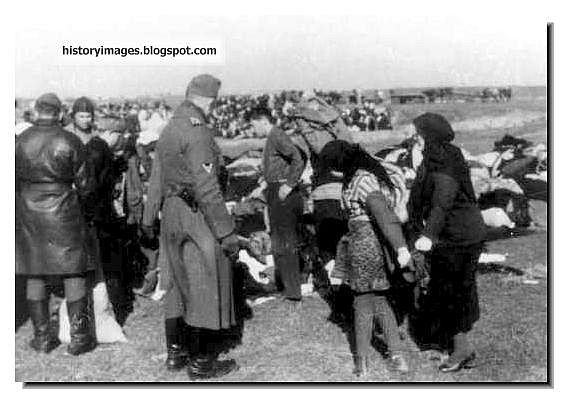
It is well known that Hitler attacked Poland because that would be the gateway to enslave the 'barbaric slavs' in Russia. But there was one other reason. The massacres of Germans in Danzig corridor in 1939. You may say this gave Hitler the perfect excuse to attack Poland. It gave a justification to the German people for the invasion of Poland.
The nationalistic military regime in Poland had discriminated heavily against the German ethnic minority in the interwar years. At the onset of the German invasion in September 1939, gripped by fears of sabotage behind the lines, it had arrested between ten and fifteen thousand ethnic Germans and marched them towards the eastern part of the country, beating laggards and shooting many of those who gave up through exhaustion. There were also widespread attacks on members of the ethnic German minority, most of whom had made no attempt to disguise their desire to return to the German Reich ever since their forcible incorporation into Poland at the end of the First World War. Altogether, around 2,000 ethnic Germans were killed in mass shootings or died from exhaustion on the marches. Some 300 were killed in Bromberg (Bydgoszcz), where local ethnic Germans had staged an armed uprising against the town’s garrison in the belief that the war was virtually over, and had been killed by the enraged Poles.
From Third Reich At War by Richard J. Evans
The 1939 Danzig Massacres
he Polish Bolsheviks kill 58,000 German Nationals in the Danzig corridor In the months leading up to the German invasion the Polish Army and independent Bolshevik units had been slaughtering German nationals in theDanzig corridor. Mass killings of thousands of civilian ethnic Germans (Volksdeutsche) by both civilian and Russian NDVK Jews, who were confident that Poland would quickly defeat Germany. Many apparently expected to take possession of German farms and businesses. An estimated 58,000 German civilians lost their lives in the massacres carried out prior to the 1939 invasion. Poles had been merrily slaughtering anything or anybody German since at least as early as April 1939, with smaller incidents stretching back to the close of WW I .
There were hardly any good guys in the Second World war, were there?
To understand how the war in 1939 between Poland and Germany, and consequently WW2, unfolded, it is not sufficient to look at - and accept - the widely-held view that peace-loving and weak little Poland was attacked by an ever-marauding National Socialist Germany. Rather, one must look much deeper into history. This conflict which cost many millions of lives did not originate with the German invasion of Poland on September 1, 1939, as is still claimed today by over-simplifying historians. It is not just a black-and-white story, but a complex one. It was also not caused by the Polish mobilization of her army two days previous, on August 30, 1939, although the mobilization of a country's army, according to international standards, is equal to a declaration of war on the neighboring country.
The German invasion of Poland in 1939 still rouses passions even today. German conservative CDU politician Erica Steinbach raised a hornet's nest when she alleged in September 2010 Hitler's attack on Poland in 1939 was in response to mobilisation by Poland.
Source: http://www.wintersonnenwende.com/scriptorium/english/archives/articles/wrsynopsis.html
Suggested Reading: http://archive.org/stream/PolishAtrocitiesAgainstTheGermanMinorityInPoland/Poland_djvu.txt
-----------------------
by
HUGH SETON-WATSON

The New York Times Book Review called him "the outstanding authority on the satellite countries of Eastern Europe"
Relevant here is Chapter 8 (Page 320) of the book, titled "Polish Imperialism".
----------
Relevant here is Chapter 8 (Page 320) of the book, titled "Polish Imperialism".
----------

Murdered minority Germans before burial at a protestant graveyard in Bromberg.
 Murdered Germans near Glinke
 A German priest prays for his murdered countrymen in Bromberg.
 Murdered and mutilated Germans near Bromberg
 A German woman near the dead body of her husband.