This site may load slowly at times because of the numerous images. Please reload the page if some of the images do not appear. Thank you.

Search This Site

Brutal Japanese: Rape of Nanking 1937


The Nanking Massacre or Nanjing Massacre, also known as the Rape of Nanking, is a mass murder and war rape that occurred during the six-week period following the Japanese capture of the city of Nanjing (Nanking), the former capital of the Republic of China, on December 13, 1937 during the Second Sino-Japanese War. During this period, hundreds of thousands of Chinese civilians and disarmed soldiers were murdered and 20,000–80,000 women were raped by soldiers of the Imperial Japanese Army.

History casts long shadows. The roots of the present tension between China and Japan lies in the barbaric way the Japanese acted during their occupation of China during WW2. Especially stands out the Nanking Massacre. There were no military benefits of such killings. What happened at Nanking was stupid in a way. It stiffened Chinese resistance. It also labelled the Japanese soldier as a mindless brute, which was true, the Bushido culture withstanding. So when the Americans came they thought little of the "yellow vermin" and shot POW outright, firebombed japanese cities and finally atom bombed Japan.
japanese soldiers executing chinese civilian nanking 1937
HOW IT HAPPENED

In August 1937, the Japanese army invaded Shanghai and there they met strong resistance and suffered heavy casualties. The battle was bloody as both sides faced attrition in urban hand-to-hand combat. By mid-November the Japanese had captured Shanghai with the help of naval bombardment. The General Staff Headquarters in Tokyo initially decided not to expand the war due to heavy casualties incurred and the low morale of the troops. However, on December 1, headquarters ordered the Central China Area Army and the 10th Army to capture Nanking, then-capital of the Republic of China.

After losing the Battle of Shanghai, Chiang Kai-shek knew the fall of Nanking would be simply a matter of time. He and his staff realized that he could not risk annihilation of their elite troops in a symbolic but hopeless defense of the capital. In order to preserve the army for future battles, most of them were withdrawn. Chiang Kai-shek's strategy was to follow the suggestion of his German advisers to draw the Japanese army deep into China utilizing China's vast territory as a defensive strength. Chiang planned to fight a protracted war of attrition by wearing down the Japanese in the hinterland of China.

Leaving General Tang Shengzhi in charge of the city for the Battle of Nanking, Chiang and many of his advisors flew to Wuhan, where they stayed until it was attacked in 1938.

In a press release to foreign reporters, Tang Shengzhi announced the city would not surrender and would fight to the death. Tang gathered about 100,000 soldiers, largely untrained, including Chinese troops who had participated in the Battle of Shanghai. To prevent civilians from fleeing the city, he ordered troops to guard the port, as instructed by Chiang Kai-shek. The defense force blocked roads, destroyed boats, and burnt nearby villages, preventing widespread evacuation.

The Chinese government left for relocation on December 1, and the president left on December 7, leaving the fate of Nanking to an International Committee led by John Rabe.

The defense plan fell apart quickly. Those defending the city encountered Chinese troops fleeing from previous defeats such as the Battle of Shanghai, running from the advancing Japanese army. This did nothing to help the morale of the defenders.

japanese soldiers enter nanking
The Japanese army enters Nanking

Eyewitness accounts of Westerners and Chinese present at Nanking in the weeks after the fall of the city state that over the course of six weeks following the fall of Nanking, Japanese troops engaged in rape, murder, theft, arson, and other war crimes. Some of these accounts came from foreigners who opted to stay behind in order to protect Chinese civilians from harm, including the diaries of German John Rabe and American Minnie Vautrin. Other accounts include first-person testimonies of the Nanking Massacre survivors, eyewitness reports of journalists (both Western and Japanese), as well as the field diaries of military personnel. An American missionary, John Magee, stayed behind to provide a 16 mm film documentary and first-hand photographs of the Nanking Massacre.

A group of foreign expatriates headed by John Rabe had formed the 15-man International Committee on November 22 and mapped out the Nanking Safety Zone in order to safeguard civilians in the city, where the population numbered from 200,000 to 250,000. Rabe and American missionary Lewis S. C. Smythe, secretary of the International Committee and a professor of sociology at the University of Nanking, recorded the actions of the Japanese troops and filed complaints to the Japanese embassy.
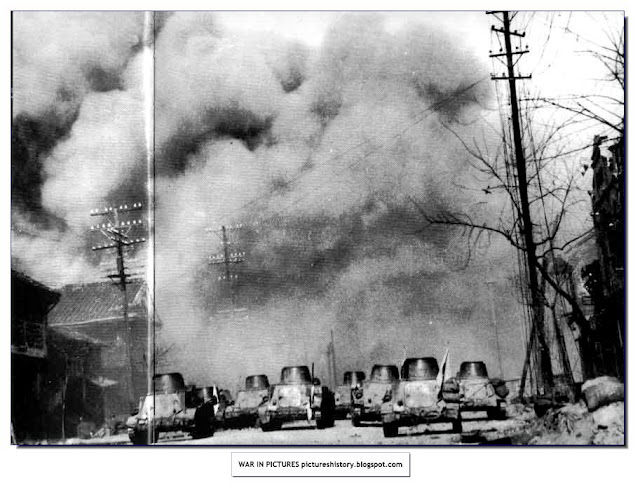
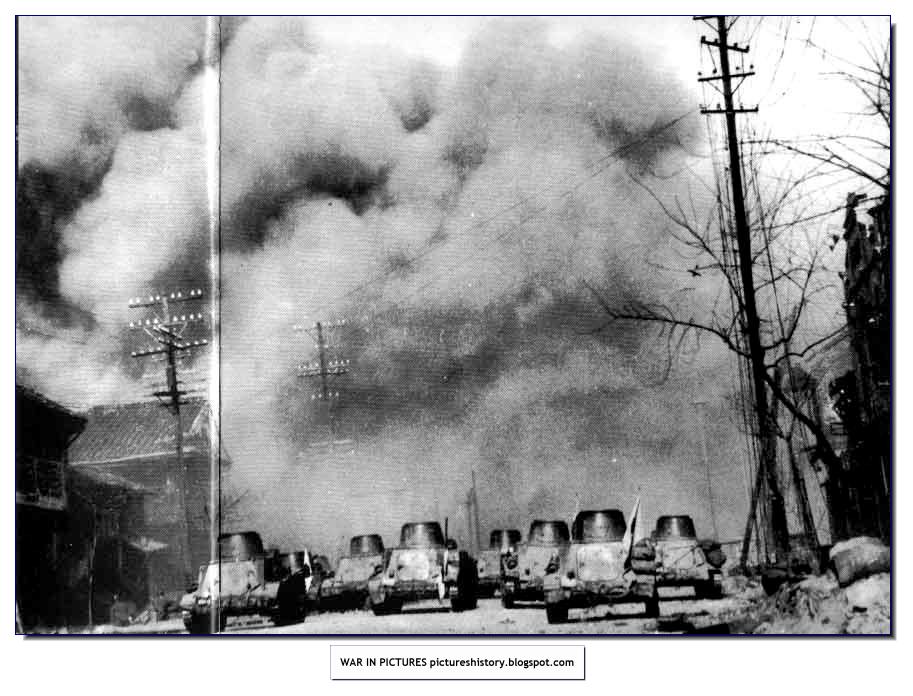
japanese tanks nanjing
 Japanese tanks enter Nanking

bayoneting chinese soldiers
The International Military Tribunal for the Far East estimated that 20,000 women were raped, including infants and the elderly. A large portion of these rapes were systematized in a process where soldiers would search door-to-door for young girls, with many women taken captive and gang raped. The women were often killed immediately after the rape, often through explicit mutilation or by stabbing a bayonet, long stick of bamboo, or other objects into the vagina.

On 19 December 1937, Reverend James M. McCallum wrote in his diary:

I know not where to end. Never I have heard or read such brutality. Rape! Rape! Rape! We estimate at least 1,000 cases a night, and many by day. In case of resistance or anything that seems like disapproval, there is a bayonet stab or a bullet ... People are hysterical ... Women are being carried off every morning, afternoon and evening. The whole Japanese army seems to be free to go and come as it pleases, and to do whatever it pleases.

On March 7, 1938, Robert O. Wilson, a surgeon at the American-administered University Hospital in the Safety Zone, wrote in a letter to his family, "a conservative estimate of people slaughtered in cold blood is somewhere about 100,000, including of course thousands of soldiers that had thrown down their arms".

Here are two excerpts from his letters of 15 and 18 December 1937 to his family:

The slaughter of civilians is appalling. I could go on for pages telling of cases of rape and brutality almost beyond belief. Two bayoneted corpses are the only survivors of seven street cleaners who were sitting in their headquarters when Japanese soldiers came in without warning or reason and killed five of their number and wounded the two that found their way to the hospital.

Let me recount some instances occurring in the last two days. Last night the house of one of the Chinese staff members of the university was broken into and two of the women, his relatives, were raped. Two girls, about 16, were raped to death in one of the refugee camps. In the University Middle School where there are 8,000 people the Japs came in ten times last night, over the wall, stole food, clothing, and raped until they were satisfied. They bayoneted one little boy of eight who have [sic] five bayonet wounds including one that penetrated his stomach, a portion of omentum was outside the abdomen. I think he will live.

In his diary kept during the aggression to the city and its occupation by the Imperial Japanese Army, the leader of the Safety Zone, John Rabe, wrote many comments about Japanese atrocities. For the 17th December:

Two Japanese soldiers have climbed over the garden wall and are about to break into our house. When I appear they give the excuse that they saw two Chinese soldiers climb over the wall. When I show them my party badge, they return the same way. In one of the houses in the narrow street behind my garden wall, a woman was raped, and then wounded in the neck with a bayonet. I managed to get an ambulance so we can take her to Kulou Hospital ... Last night up to 1,000 women and girls are said to have been raped, about 100 girls at Ginling College Girls alone. You hear nothing but rape. If husbands or brothers intervene, they're shot. What you hear and see on all sides is the brutality and bestiality of the Japanese soldiers.

There are also accounts of Japanese troops forcing families to commit acts of incest. Sons were forced to rape their mothers, fathers were forced to rape daughters. One pregnant woman who was gang-raped by Japanese soldiers gave birth only a few hours later; although the baby appeared to be physically unharmed (Robert B. Edgerton, Warriors of the Rising Sun). Monks who had declared a life of celibacy were also forced to rape women.
torturing chinese people nanking

On 13 December 1937, John Rabe wrote in his diary:

It is not until we tour the city that we learn the extent of destruction. We come across corpses every 100 to 200 yards. The bodies of civilians that I examined had bullet holes in their backs. These people had presumably been fleeing and were shot from behind. The Japanese march through the city in groups of ten to twenty soldiers and loot the shops (...) I watched with my own eyes as they looted the café of our German baker Herr Kiessling. Hempel's hotel was broken into as well, as almost every shop on Chung Shang and Taiping Road.

On 10 February 1938, Legation Secretary of the German Embassy, Rosen, wrote to his Foreign Ministry about a film made in December by Reverend John Magee to recommend its purchase. Here is an excerpt from his letter and a description of some of its shots, kept in the Political Archives of the Foreign Ministry in Berlin.

During the Japanese reign of terror in Nanking – which, by the way, continues to this day to a considerable degree – the Reverend John Magee, a member of the American Episcopal Church Mission who has been here for almost a quarter of a century, took motion pictures that eloquently bear witness to the atrocities committed by the Japanese .... One will have to wait and see whether the highest officers in the Japanese army succeed, as they have indicated, in stopping the activities of their troops, which continue even today.

On December 13, about 30 soldiers came to a Chinese house at #5 Hsing Lu Koo in the southeastern part of Nanking, and demanded entrance. The door was open by the landlord, a Mohammedan named Ha. They killed him immediately with a revolver and also Mrs. Ha, who knelt before them after Ha's death, begging them not to kill anyone else. Mrs. Ha asked them why they killed her husband and they shot her. Mrs. Hsia was dragged out from under a table in the guest hall where she had tried to hide with her 1 year old baby. After being stripped and raped by one or more men, she was bayoneted in the chest, and then had a bottle thrust into her vagina. The baby was killed with a bayonet. Some soldiers then went to the next room, where Mrs. Hsia's parents, aged 76 and 74, and. The soldiers killed her with a revolver. The grandfather grasped the body of his wife and was killed. The two girls were then stripped, the elder being raped by 2–3 men, and the younger by 3. The older girl was stabbed afterwards and a cane was rammed in her vagina. The younger girl was bayoneted also but was spared the horrible treatment that had been meted out to her sister and mother. The soldiers then bayoneted another sister of between 7–8, who was also in the room. The last murders in the house were of Ha's two children, aged 4 and 2 respectively. The older was bayoneted and the younger split down through the head with a sword.

Pregnant women were a target of murder, as they would often be bayoneted in the stomach, sometimes after rape. Tang Junshan, survivor and witness to one of the Japanese army’s systematic mass killings, testified:

The seventh and last person in the first row was a pregnant woman. The soldier thought he might as well rape her before killing her, so he pulled her out of the group to a spot about ten meters away. As he was trying to rape her, the woman resisted fiercely ... The soldier abruptly stabbed her in the belly with a bayonet. She gave a final scream as her intestines spilled out. Then the soldier stabbed the fetus, with its umbilical cord clearly visible, and tossed it aside.

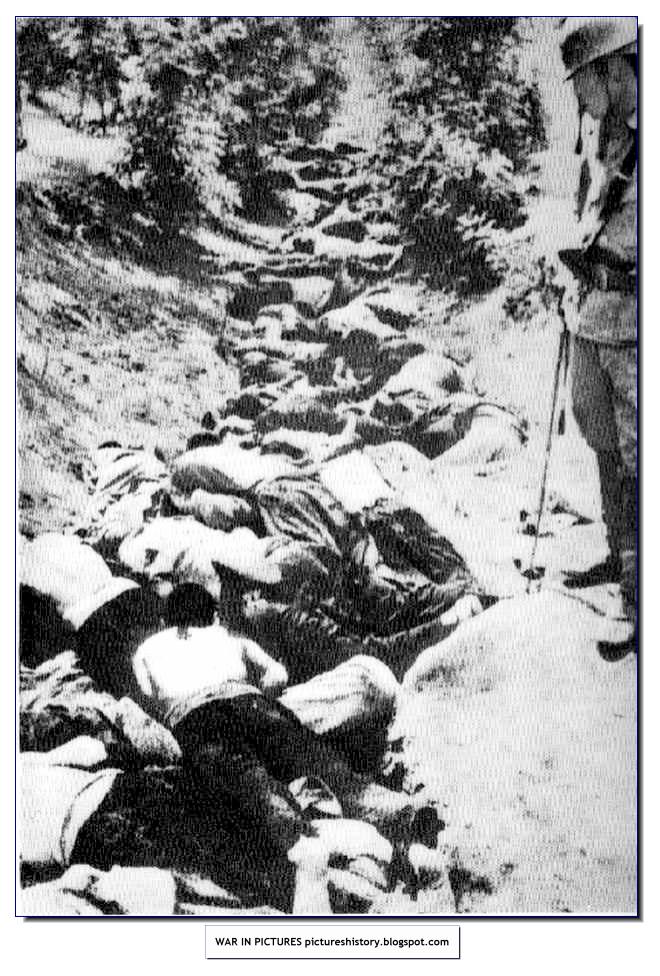
According to Navy veteran Sho Mitani, «The Army used a trumpet sound that meant "Kill all Chinese who run away"». Thousands were led away and mass-executed in an excavation known as the "Ten-Thousand-Corpse Ditch", a trench measuring about 300m long and 5m wide. Since records were not kept, estimates regarding the number of victims buried in the ditch range from 4,000 to 20,000. However, most scholars and historians consider the number to be more than 12,000 victims.
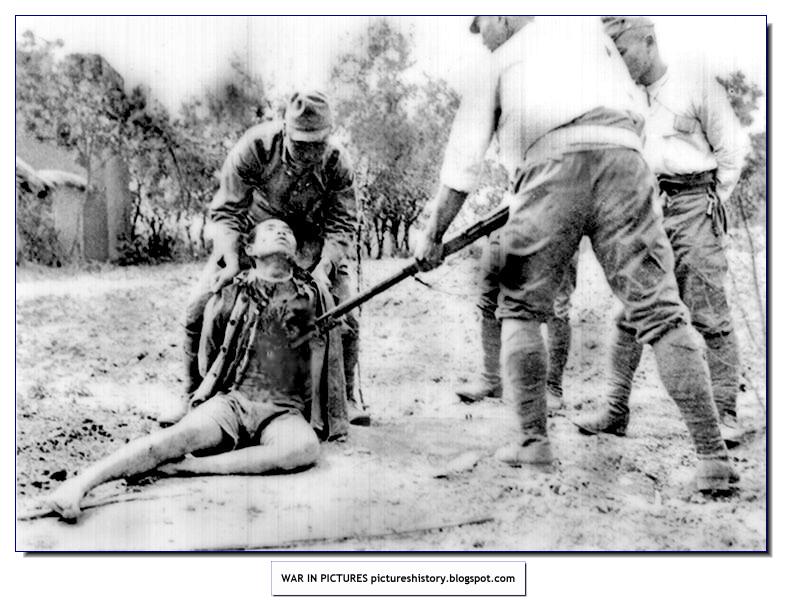
On August 6, 1937, Hirohito had personally ratified his army's proposition to remove the constraints of international law on the treatment of Chinese prisoners. This directive also advised staff officers to stop using the term "prisoner of war".

Immediately after the fall of the city, Japanese troops embarked on a determined search for former soldiers, in which thousands of young men were captured. Many were taken to the Yangtze River, where they were machine-gunned. What was probably the single largest massacre of Chinese troops occurred along the banks of the Yangtze River on December 18 in what is called the Straw String Gorge Massacre. Japanese soldiers took most of the morning tying all of the POWs hands together and in the dusk divided them into 4 columns, and opened fire at them. Unable to escape, the POWs could only scream and thrash in desperation. It took an hour for the sounds of death to stop, and even longer for the Japanese to bayonet each individual. Most were dumped into the Yangtze. It is estimated that at least 57,500 Chinese POWs were killed.

The Japanese troops gathered 1,300 Chinese soldiers and civilians at Taiping Gate and killed them. The victims were blown up with landmines, then doused with petrol before being set on fire. Those that were left alive afterward were killed with bayonets.

F. Tillman Durdin and Archibald Steele, American news correspondents, reported that they had seen bodies of killed Chinese soldiers forming mounds six feet high at the Nanking Yijiang gate in the north. Durdin, who was working for the New York Times, made a tour of Nanking before his departure from the city. He heard waves of machine-gun fire and witnessed the Japanese soldiers gun down some two hundred Chinese within ten minutes. Two days later, in his report to the New York Times, he stated that the alleys and street were filled with civilian bodies, including women and children.

According to a testimony made by missionary Ralph L. Phillips to the U.S. State Assembly Investigating Committee, he was "forced to watch while the Japs disembowled a Chinese soldier" and "roasted his heart and liver and ate them"
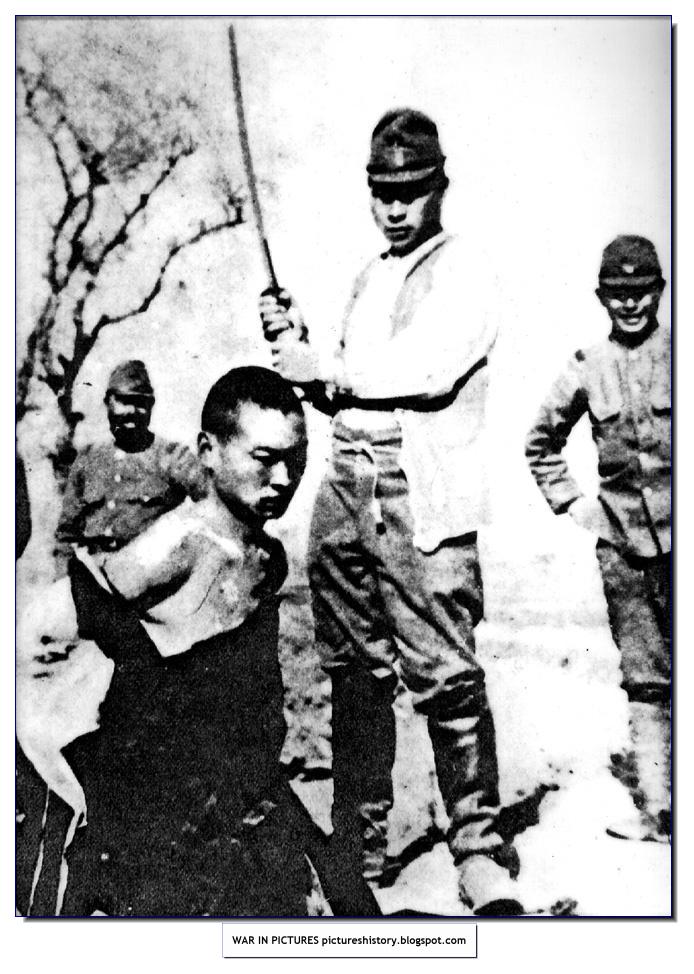
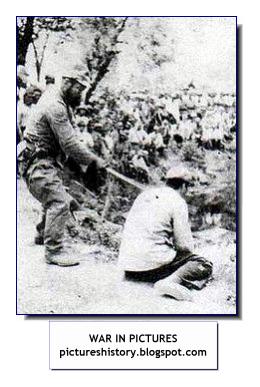
beheading chinese man with sword
HOW LONG DID THE MASSACRE LAST?

The Battle of Nanking ended on December 13, when the divisions of the Japanese Army entered the walled city of Nanking. The Tokyo War Crime Tribunal defined the period of the massacre to the ensuing six weeks. More conservative estimates say the massacre started on December 14, when the troops entered the Safety Zone, and that it lasted for six weeks.

The roots of the agressive China of today perhaps lies partly in the Nanking Massacre in 1937.

japanese soldier smiles kills heartless

VODEO: BLACK SUN MASSACRE


child cries nanking railway station destroyed


dead chinese in a ditch


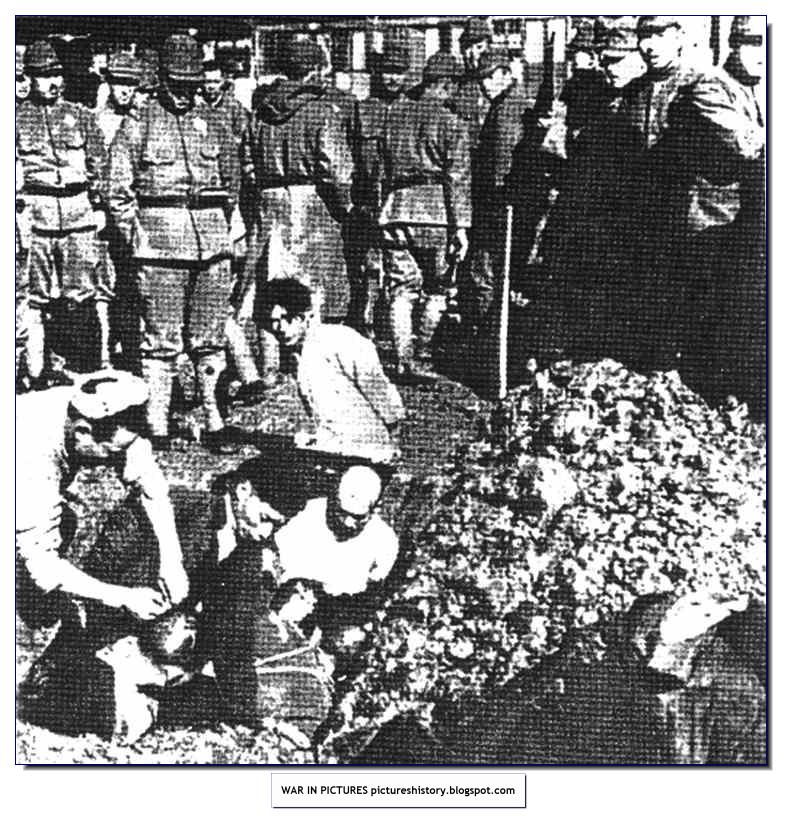
Chinese being buried alive


bodies chinese women children


A Chinese POW about to be beheaded by a Japanese officer with a shin gunto during the Nanking Massacre.


japanese killing contest
One of articles on the "Contest to kill 100 people using a sword" published in the Tokyo Nichi Nichi Shimbun. The headline reads, "'Incredible Record' (in the Contest to Cut Down 100 People) —Mukai 106 – 105 Noda—Both 2nd Lieutenants Go Into Extra Innings"

The sheer volume of murdered civilians posed a formidable logistical challenge when it came to disposing of the bodies. Many Chinese were conscripted into "burial teams

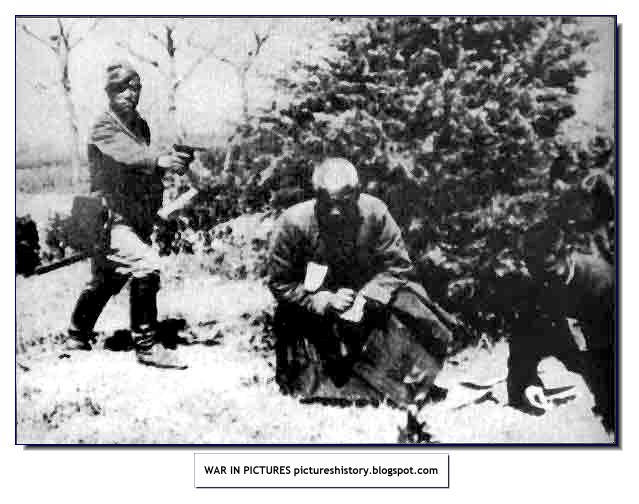
shooting chinese man


Please note that there are many more images available on the rape and massacre that occurred at Nanking. We have shunned showing the more graphic images on this site. They can be viewed at Nanking-massacre.com


-------------------------------------------------------
Suggested Reading

 RAPE OF NANKING iris chang book

Share this PostPin ThisShare on TumblrShare on Google PlusEmail This

Russian Brutality: Massacres By Russian Soldiers During WW2

The eastern front was a hard place to be in. If the SS and gestapo did evil things in Russia, the Russian soldiers were no angels too. Here are some instances where German soldiers were massacred by the Russians. The Russians killed soldiers of other nations too. And we do not mention here the mass rapes in Berlin which started in April 1945.


KATYN FOREST (Smolensk, 1939-40)

In 1939, during the Russian invasion of Poland, some 14,500 Polish officers were captured and interned in three P.O.W. camps in the Soviet Union. The next time the world heard of these prisoners was a news broadcast on April 13, 1943, from Radio Berlin. It stated that the German Army had discovered mass graves at Katyn, 18 kilometres north-west of Smolensk, near the village of Gneizdovo and containing the bodies of Polish officers. Eight graves were opened and 4,253 bodies exhumed.


VIDEO: KATYN: PART 1


KATYN: PART 2


Katyn Forest massacre


All were dressed in Polish uniforms, with badges of rank and medals intact. No watches or rings were found on the corpses. It was established that the bodies were of Polish officers from the camp at Kozielsk, situated in the grounds of a former Monastery, near Orel. Two other camps, at Starobielsk (3,891 men) and at Ostashkov (6,311 men) were wound up and closed in the first days of April, 1940. Whatever happened to these 10,000 odd officers has never been established. They were never seen alive again. From evidence obtained after the war, all prisoners of Kozielsk camp were shot by Stalin's NKVD.


Red Army kills polish officers in the head

On April 13, 1990, fifty years after the massacre, the USSR for the first time admitted its responsibility for the murders. The whole controversy was finally laid to rest when Boris Yeltsin, handed over the secret files on Katyn to the Polish president, Lech Walesa, on October 14, 1992. In May 1992, in a wood near Kharkov, a Russian private investigation team discovered a mass grave containing 3,891 bodies of Polish officers from the camp at Starobielsk in the Ukraine. In June of that year, Soviet authorities discovered 30 mass graves at Miednoje, one hundred miles north-west of Moscow. They contained the remains of 6,287 Polish prisoners from the Ostashkov island camp on Lake Seliguer. Before the massacre, 245 officers from Kozielsk, 79 from Starobielsk and 124 from the camp at Ostashkor , were transferred, for no apparent reason, to a camp at Pavlishchev Bor, a hundred miles north-west of the Kozielsk camp. These 448 officers proved to be the only survivors of the Katyn massacre. KGB files state that 21,857 Poles were shot as a result of Stalin's order. In other parts of the Katyn Forest, other graves were discovered containing the bodies of Russian political prisoners who were executed in pre-war days by the NKVD. It seems that the Katyn Forest was the main execution site for Stalin’s secret police. (Not to be confused with the Khatyn murder site near Minsk) All mention of the Katyn atrocity has been removed from Soviet history textbooks.


VIDEO


MURDER AT BRONIKI, UKRAINE

On July 1st 1941, around 180 German soldiers of the 2nd and 6th Infantry Regiments and the 5th Artillery Regiment were taken prisoner by the Red Army in the town of Broniki. Most were suffering from battle wounds. Next day, the 2nd of July, advancing Wehrmacht troops discovered 153 bodies in a clover field near the town. All had been brutally murdered. According to the twelve survivors of the massacre, they were taken to the field just off the main road and forced to undress. All valuables such as money, rings, watches as well as their uniforms, shirts and shoes were stolen. Standing there naked, the prisoners were then fired upon by machine guns and automatic rifles. A few managed to escape by fleeing to the nearby woods. Similar reports from other regiments gave rise to the suspicion that the Soviets, in the early stages of the war, were not taking any prisoners. There was a division order, according to which every Russian soldier who shoots twenty German soldiers, received a three day leave pass to go home. He also was decorated and raised in rank.


THE GRISCHINO MASSACRE (February 18, 1943)


The area of Grischino lies to the north-west of Stalino (now Donets) an important industrial region in the Ukraine. Occupied by German forces, it was recaptured by a Soviet armored division and again recaptured by the German 7th Armored Division during a counteroffensive in February, 1943. What they found was the bodies of 406 German soldiers, (POWs) 58 were members of the Todt Organization, 89 Italian soldiers, 9 Romanian soldiers, 4 Hungarian soldiers and some civilian workers, Ukrainian volunteers and German nurses. A total of 596 souls had been killed. Most were shot after being dragged from their hiding places in cellars. Many of the bodies were horribly mutilated, ears and noses cut off and genital organs amputated and stuffed into their mouths. Breasts of some of the nurses were cut off, the women being brutally raped. In the cellar of the main train station around 120 Germans were herded into a large storage room and then mowed down with machine guns. It was realized that the Russians had killed every single German they had found there. As with most massacres, there were survivors and in this case, civilian witnesses.

During the week of 22/29 June, 1941, thousands of Ukrainian and Polish political prisoners were murdered in their cells by the Soviet NKVD (KGB). The Soviets' hurried retreat had tragic consequences for all political prisoners in the jails of Western Ukraine. Soon after the German attack on the Soviet Union, the retreating Soviets had no time to care for their prisoners locked up in prisons in the Ukraine, so they were simply killed. In some cities the whole prison was set on fire and the helpless prisoners burned to death. In Lutsk, 2,800 out of the 4000 inmates in the NKVD prison, were murdered. When the German 49th Army Corps occupied the Polish-Ukrainian city of Lvov, (now Limberg) around 2,400 dead bodies were found by German troops in the NKVD prison. Some were killed by hand-grenades thrown into their cells, most were killed by a shot in the neck. In the cellars of the Brygidky Prison on Palczymska Street, 423 bodies were recovered. Hundreds more were piled up in the courtyard. In the military prison at Samarstinov, which had been set on fire, 460 charred bodies were found, many showing signs of brutal torture. In the cellars, bodies were piled up layer upon layer almost to the ceiling. Owing to the stench of the decomposing corpses, the German commander of Lvov ordered all doors to the cellars bricked up after the bodies were covered with lime. On June 26-27, 1941, some 520 Ukrainians were shot at Sambor, and at Zlochev, another 700, including the entire local intelligentsia, were arrested and shot on July 16, 1941. At Kremenets, between 100 and 150 were killed and when the bodies were recovered some bodies were without skin, having been thrown into boiling water.

Altogether, in the Ukraine, around 10,000 Ukrainian and Polish political prisoners were killed in their prisons. It is a sad fact that many members of the NKVD execution squads in the Ukraine, were Jewish collaborators. These collaborators were hated by other Jews more than the German SS. (A memorial plaque at the former headquarters of the NKVD/KGB in Simferpol, Ukraine, is engraved with the names of thirty NKVD agents who gave their lives in the Great Patriotic War (the Soviet name for World War II). The amazing thing is that all thirty names are Jewish! About half a million Jews served in the Red Army and approximately 200,000 were killed. A total of 160,000 Jewish soldiers were decorated with Soviet awards, 145 receiving the highest Soviet award, 'Hero of the Soviet Union'. Two Jewish women were also awarded this honour. (Many Soviet soldiers, after capture, joined the Waffen SS. The 30th SS Division was composed of such troops)


ATROCITY AT FEODOSIA (December 29, 1941)

On the shores of the Black Sea, on the Crimean Peninsula, stands the port city of Feodosia. On the 3rd of November the city was captured by the German 46th and 170th Infantry Divisions. As the attack on Sevastopol was about to take place, most of the German forces were withdrawn to concentrate on the forthcoming battle. Left behind in the city were a small detachment of troops and all the wounded soldiers convalescing in the city's hospitals. On the afternoon of December 29, the city was bombarded by the Soviet Black Sea Fleet and a landing was made by Soviet marines followed by infantry. On the 18th of January, 1942, after their failure to capture Sevastopol, the German Wehrmacht was able to return and recapture Feodosia. They found that most of the German military personnel had been murdered. Wounded soldiers had been thrown out of the windows of the hospital to make room for Russian wounded. Water was then poured on the near dead bodies and then left to freeze. On the beach, piles of bodies were found where they were thrown from a wall several metres high after being beaten and mutilated, their bodies left in the surf so that the sea water froze and covered them with a sheet of ice. There were some twelve survivors who had hidden in cellars when the Russian troops arrived. Their testimony before a German court of inquiry confirmed that some 160 wounded soldiers were liquidated this way.


THE KORSUN SLAUGHTER (February 16-17, 1944)

During the freezing cold night of February 16, five divisions of General Hube's 1st SS Panzer Army, (54,000 men) including the 5th SS Division Viking and the Belgian Volunteer Brigade Wallonie, made a last desperate bid to break out of the Russian encirclement around the towns of Korsun and Shandrerovka in the lower Dnieper south-west of Kiev (Kyiv). At 4am, elements of the 8th Army formed up into two marching columns of around 14,000 men each and flocked into two parallel ravines in the surrounding countryside, and where the two ravines met, the troops, now in complete disorder, then emerged into open country and headed out towards the town of Lysyanka.


Soviet soldiers kill german soldiers


There, disaster struck as troops of the 2nd Ukrainian Front, under General Konev, were waiting. Soon after 6am, the slaughter began. Soviet tanks drove into the two German columns crushing hundreds under their tracks. Fleeing in panic, the troops were then bombed and shelled before being confronted by units of Cossack cavalry who started hacking them to pieces with their sabres, There was no time to take prisoners and in the short space of three hours around 20,000 German soldiers lay dead, their bodies later dumped in holes dug in the ground. The hundreds of wounded and medical personnel left behind were butchered by the Cossacks. Only a few officers survived, most had fled the scene by plane some days before. (Russian sources put the number of dead during the two weeks of fighting at over 70,000) To reach Lysyanka the troops had first to cross the raging Gniloy-Tikich river. Reaching the opposite side many were transformed into blocks of ice their uniforms frozen to their bodies. About eight thousand others, who had fled the scene and were hiding in the woods, were rounded up during the next few days and taken prisoner. For this great victory, General Konev was awarded the title 'Marshal of the Soviet Union'.


--------------------------
During the fighting in Norway and Finland, the SS Gebirgsdivision 'Nord', was opposing the Russian forces. Very few SS men were taken prisoners by the Red Army, most were shot immediately. A report on Operation No 11 from the Soviet 26th Division states: 'The enemy left approximately 400 dead on the battlefield. Some 80 Germans had surrendered and were executed'.

In the notes found on a Soviet doctor after he was captured, he had written: 'All POWs who belonged to the German Army were executed during the operations near Odessa'.

Soviet archives reveal the following: 'July 7, 1943, the enemy suffered great losses...we did not take any prisoners, they were all liquidated'.


-------------------------------
Waffen ss soldiers tortured killed

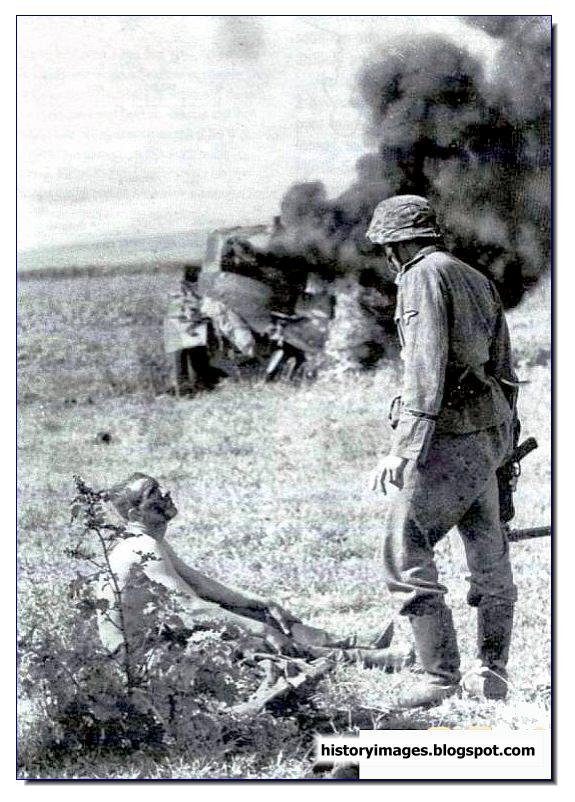
This photo shows one of 34 german soldiers of 9th SS-Panzer-Division "Hohenstaufen" that were captured by the Red Army in April 1944 in the ukrainian village of Kalasantovka. The mutilated bodies were found by their comrades during the german counter attack on the near-by town of Ternopil. A german eyewitness: "That's not the way soldiers are supposed to act. The hands and the feet of the dead were bound with the ropes of their own tentpieces. Partially the trousers were pulled down and genitals severed. With some the eyes were stabbed, ears and tongue cut off. Furthermore their own bayonet was rammed into the stomach from the downside. Dogtags and other ID's were removed to avoid an identification of the dead. Fortunately most of them had their last names sewn on the inside of their uniform pieces so that a list of the victims could be compiled. However this list was lost later on so that these 34 soldiers are considered officially as "Missing in Action".

Source: ww2incolor


-----------------------------

RUSSIAN BRUTALITY IN KOENIGSBURG 1945

During the last months of the war, the ancient German city of Königsberg in East Prussia held out as a strongly defended urban fortress. After repeated attack and siege by the Red Army, it finally surrendered in early April 1945. Soviet troops then ravished the civilian population. The people were beaten, robbed, killed and, if female, raped. The rape victims included nuns. Even hospital patients were robbed of their possessions. Bunkers and shelters, packed with terrified people huddling inside, were torched with flame-throwers. About 40,000 of the city’s population were killed, or took their own lives to escape the horrors, and the remaining 73,000 Germans were brutally deported.

IHR.ORG


------------------------------

In October 1945, a New York Daily News report from occupied Berlin told readers:


 “In the windswept courtyard of the Stettiner Bahnof [rail station], a cohort of German refugees, part of 12 million to 19 million dispossessed in East Prussia and Silesia, sat in groups under a driving rain and told the story of their miserable pilgrimage, during which more than 25 percent died by the roadside, and the remainder were so starved they scarcely had strength to walk … 

 “A nurse from Stettin, a young, good-looking blond, told how her father had been stabbed to death by Russian soldiers who, after raping her mother and sister, tried to break into her own room. She escaped and hid in a haystack with four other women for four days … 

 “On the train to Berlin she was pillaged once by Russian troops and twice by Poles. Women who resisted were shot dead, she said, and on one occasion she saw a guard take an infant by the legs and crush its skull against a post because the child cried while the guard was raping its mother. 

 “An old peasant from Silesia said ... victims were robbed of everything they had, even their shoes. Infants were robbed of their swaddling clothes so that they froze to death. All the healthy girls and women, even those 65 years of age, were raped in the train and then robbed, the peasant said.”

Share this PostPin ThisShare on TumblrShare on Google PlusEmail This

American Soldiers Gone 'Bad' During WW2

Japanese Heads used as Jeep Headlights


During World War II, United States military personnel mutilated dead Japanese service personnel in the Pacific theater of operations. The mutilation of Japanese service personnel included the taking of body parts as “war souvenirs” and “war trophies”. Teeth and skulls were the most commonly taken "trophies", although other body parts were also collected.

The phenomenon of "trophy-taking" was widespread enough that discussion of it featured prominently in magazines and newspapers, and Franklin Roosevelt himself was reportedly given a gift of a letter-opener made of a man's arm (Roosevelt rejected the gift and called for its proper burial). The behavior was officially prohibited by the U.S. military, which issued additional guidance as early as 1942 condemning it specifically. Nonetheless, the behavior continued throughout the war in the Pacific Theater, and has resulted in continued discoveries of "trophy skulls" of Japanese combatants in American possession, as well as American and Japanese efforts to repatriate the remains of the Japanese dead.

The earliest account of U.S. troops wearing ears from Japanese corpses he recounts took according to one Marine place on the second day of the Guadalcanal Campaign in August 1942 and occurred after photos of the mutilated bodies of Marines on Wake Island were found in Japanese engineers' personal effects. The account of the same marine also states that Japanese troops booby trapped some of their own dead as well as some dead marines, and also mutilated corpses; the effect on marines being "We began to get down to their level". According to Bradley A. Thayer, referring to Bergerud and interviews conducted by Bergerud, the behaviors of American and Australian soldiers were affected by "intense fear, coupled with a powerful lust for revenge".

On February 1, 1943, Life magazine published a photograph taken by Ralph Morse during the Guadalcanal campaign showing a decapitated Japanese head that US marines had propped up below the gun turret of a tank. Life received letters of protest from people "in disbelief that American soldiers were capable of such brutality toward the enemy." The editors responded that "war is unpleasant, cruel, and inhuman. And it is more dangerous to forget this than to be shocked by reminders." However, the image of the decapitated head generated less than half the amount of protest letters that an image of a mistreated cat in the very same issue received.

Weingartner writes however that U.S. Marines were intent on taking gold teeth and making keepsakes of Japanese ears already while en-route to Guadacanal.

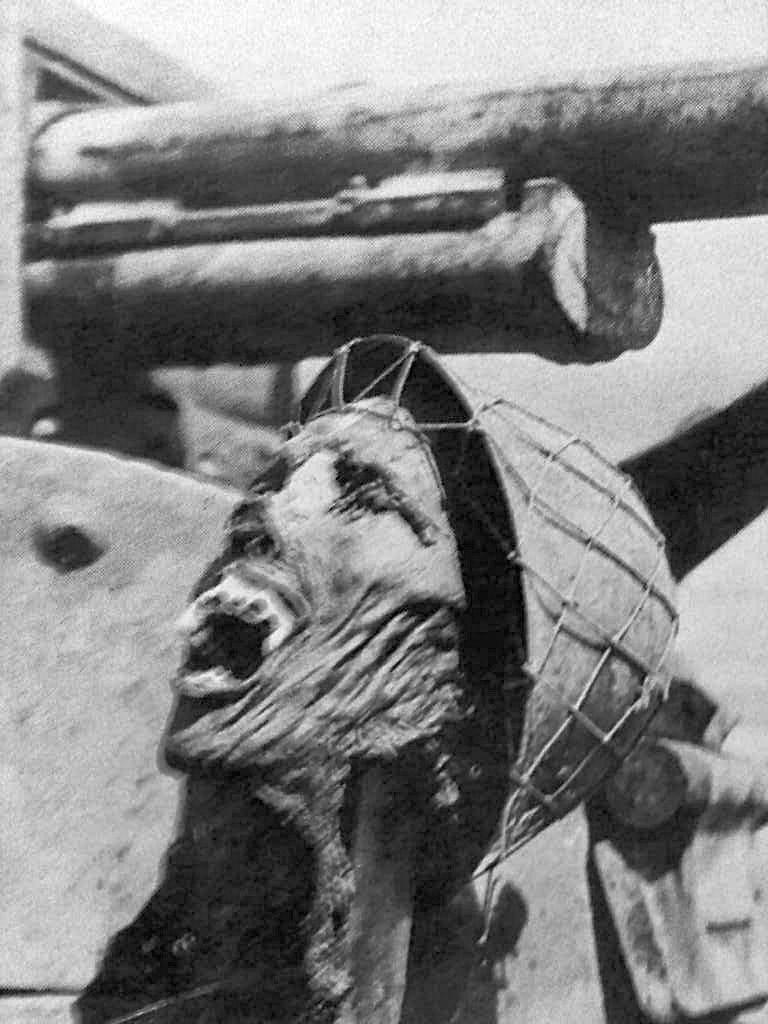
"Japanese skulls were much-envied trophies among U.S. Marines in the Pacific theater during World War II. The practice of collecting them apparently began after the bloody conflict on Guadalcanal, when the troops set up the skulls as ornaments or totems atop poles as a type of warning. The Marines boiled the skulls and then used lye to remove any residual flesh so they would be suitable as souvenirs. U.S. sailors cleaned their trophy skulls by putting them in nets and dragging them behind their vessels. Winfield Townley Scott wrote a wartime poem, 'The U.S. Sailor with the Japanese Skull" that detailed the entire technique of preserving the headskull as a souvenir. Referring to this practice, Edward L. Jones, a U.S. war correspondent in the Pacific wrote in the February 1946 Atlantic Magazine, "We boiled the flesh off enemy skulls to make table ornaments for sweethearts, or carved their bones into letter-openers." On occasion, these "Japanese trophy skulls" have confused police when they have turned up during murder investigations. It has been reported that when the remains of Japanese soldiers were repatriated from the Mariana Islands in 1984, sixty percent were missing their skulls."

The collection of Japanese body parts began quite early in the war, prompting a September 1942 order for disciplinary action against such souvenir taking.

Harrison concludes that, since this was the first real opportunity to take such items (The Battle of Guadalcanal), "clearly, the collection of body parts on a scale large enough to concern the military authorities had started as soon as the first living or dead Japanese bodies were encountered."

When Japanese remains were repatriated from the Mariana Islands after the war, roughly 60 percent were missing their skulls.

Japanese soldier's decapitated head hung on a tree branch in Burma, probably by American soldiers. 1945. Source of Photo; US National Archives.
Trophy skulls are the most notorious of the so-called "souvenirs". Teeth, ears and other such body parts were occasionally modified, for example by writing on them or fashioning them into utilities or other artifacts.

Eugene Sledge relates a few instances of fellow Marines extracting gold teeth from the Japanese, including one from an enemy soldier who was still alive.

But the Japanese wasn't dead. He had been wounded severely in the back and couldn't move his arms; otherwise he would have resisted to his last breath. The Japanese's mouth glowed with huge gold-crowned teeth, and his captor wanted them. He put the point of his kabar on the base of a tooth and hit the handle with the palm of his hand. Because the Japanese was kicking his feet and thrashing about, the knife point glanced off the tooth and sank deeply into the victim's mouth. The Marine cursed him and with a slash cut his cheeks open to each ear. He put his foot on the sufferer's lower jaw and tried again. Blood poured out of the soldier's mouth. He made a gurgling noise and thrashed wildly. I shouted, “Put the man out of his misery.” All I got for an answer was a cussing out. Another Marine ran up, put a bullet in the enemy soldier's brain, and ended his agony. The scavenger grumbled and continued extracting his prizes undisturbed.

In October 1943, the U.S. High Command expressed alarm over recent newspaper articles, for example one where a soldier made a string of beads using Japanese teeth, and another about a soldier with pictures showing the steps in preparing a skull, involving cooking and scraping of the Japanese heads.

Skull stewing Charles Lindbergh refers in his diary to a conversation he had with a marine officer, who claimed that he had seen many Japanese corpses with an ear or nose cut off. In the case of the skulls however, most were not collected from freshly killed Japanese; most came from already partially or fully skeletonised Japanese bodies.

Front line warning sign using a Japanese soldier's skull on Peleliu  Source: - National Park Service - National Archives #98501

In a memorandum dated June 13, 1944, the U.S. Army Judge Advocate General (JAG) asserted that "such atrocious and brutal policies," in addition to being repugnant, were violations of the laws of war, and recommended the distribution to all commanders of a directive pointing out that "the maltreatment of enemy war dead was a blatant violation of the 1929 Geneva Convention on the sick and wounded, which provided that: After every engagement, the belligerent who remains in possession of the field shall take measures to search for wounded and the dead and to protect them from robbery and ill treatment."

These practises were in addition also in violation of the unwritten customary rules of land warfare and could lead to the death penalty. The U.S. Navy JAG mirrored that opinion one week later, and also added that "the atrocious conduct of which some US personnel were guilty could lead to retaliation by the Japanese which would be justified under international law".

RELATED

American Soldiers Hated And Brutalised Waffen SS Prisoners

Inglorious American Soldiers: MASSACRE AT LIPPACH

American Soldiers Raped German Women During WW2

Inglorious American Soldiers: KILLING OF GERMAN POW AT Jungholhausen

SHOCKING! American Soldiers (And Allies) 


Sources:
James J. Weingartner "Trophies of War: U.S. Troops and the Mutilation of Japanese War Dead, 1941–1945" Pacific Historical Review (1992)

Simon Harrison “Skull Trophies of the Pacific War: transgressive objects of remembrance” Journal of the Royal Anthropological Institute (N.S) 12, 817–836 (2006)

Kenneth V. Iserson, M.D., Death to Dust: What happens to Dead Bodies?, Galen Press, Ltd. Tucson, AZ. 1994.

Bradley A. Thayer, "Darwin and international relations" 

Article Source: http://www.canadaatwar.ca/forums/showthread.php?t=2398

Share this PostPin ThisShare on TumblrShare on Google PlusEmail This

When Germans Hanged The First Soviet Partisans In 1941....

The war on the WW2 Eastern Front was Total War, Absolute War....Call it anything...It was brutal.

After the Germans swept through Soviet Union in 1941, partisans activity in the occupied territories started prompted by Moscow. The Germans considered the partisans a serious threat (Not without reason). On October 26, 1941, the first partisans were hanged in Minsk.

Here are the chilling images....

The whole execution was filmed by a photographer. Underground workers managed to obtain duplicate pictures, which, after the liberation of Minsk were handed over to the Soviet authorities. These photos featured at the Nuremberg Trials as a document of accusations against Nazi criminals.

The captured partisans are led in a public procession to the execution site

17 year Maria Bruskin being prepared

12 partisans were hanged in all

The board hanging from the neck reads (written in German and in Russian) "We  guerrillas fired on German troops"

Share this PostPin ThisShare on TumblrShare on Google PlusEmail This

Brutal Images From Second World War

War is hell. War is man at his worst. Most bestial. Death. Pain. Violence. 

When the dogs of war are unleashed....

 A dead German soldier lies as a crow has a feast

THE BRUTAL USTASHI

THE PREBILOVCI MASSACRE

The Prebilovci Massacre was one of many atrocities perpetrated by the Croatian Ustasha regime in the Independent State of Croatia during the World War II persecution of Serbs. Roughly 650 people, women and children, almost the entire population present at the time in the village of Prebilovci, were slaughtered and thrown into natural pits in Herzegovina.

When it came to pure brutality none could beat the Croatian Ustashi. The Germans were saints in comparison. So shocked was Italian general Alexander Lausanne with the ways of the Ustashi that he fell compelled to write a letter to Mussolini about it. (As if Mussolini cared a hoot about such things!)

"Duce! My boundless loyalty to you, I hope, I have the right in some things to deviate from strict military protocol. Therefore, I hasten to describe to you the one event that occurred three weeks ago in which  I was personally.

Circling the district towns Stolac, Chaplin and Ljubinje (between 60 and 130 km. North of Dubrovnik) - I learnt from our intelligence officers that the Ustashi Pavelic committed a crime in one village (Prebilovci) and as this becomes known, the local Serbs are again worried. I have no words to describe what I found there. In a large school office, I found a teacher stabbed to death and 120 of her students killed!  No child was older than 12 years! The crime was not only inappropriate but it transcends all craziness! Many were beheaded and and their heads were placed on the school benches. The Ustashi had ripped up the stomachs dragged the intestines around and hung them like Christmas garlands from the ceiling and hammered them on the wall with nails! Swarm of flies flew around and because of the unbearable stench nobody could not stay long here.

I noticed an open bag of salt in the corner and to my horror found that the children were cut and salt sprinkled on the wound! And, when we were leaving, I heard children from the back benches moan. I sent two soldiers to see what was wrong who brought back one student who was still alive and breathing with a half dissected neck! I took this poor child in my car to our military hospital, brought it to consciousness and learnt from him the whole truth about the tragedy.

The criminals raped the teacher, a Serbian, (her name Stan Arnautovic) and then killed her in front of the children. Then all girls above eight years were raped. All this time the orchestra played forcefully! To our great shame, the Church of Rome - and a man of God, a local priest, took part in all of this!

The boy we rescued recovered quickly. And as soon as the wound healed, he escaped from the hospital and came to his village to find his relatives. We sent a patrol to find him, but to no avail: We found him stabbed on the doorstep! Of the thousands of souls who lived in the village no one survived! On the same day (as we later found out) when the offense was committed in the school, the Ustashi arrested another 700 villagers of Prebilovci and threw all of them into the pit, or were brutally killed on the way to the pit. Only about 300 men: survived only because they were able to break through the Ustashi cordon around the village and flee to the mountains! 

Killing of Serbs reached such proportions that in those places the corpses contaminated water sources. In a field in Popovo red water flowed from the pit into which 4,000 Serbs were dumped. I am personally convinced that all this brutality leaves an indelible stain on Italy and the conscience of our culture. If there is time we should distance ourselves from the Ustashi."


 Death embraced this German on the road to Rome

 The deceased soldier of the Red Army lies on the road in a suburb of Belgrade Topchidere. Yugoslav partisan fighters of People's Liberation Army of Yugoslavia pass by in a three wheel truck.


 An US soldier stands besides the bodies of 36 Belgian women and 22 children who were allegedly murdered by the men of the German Waffen SS Divisions Adolph Hitler and Hohenstaufen.

 This Chinese woman was shot by the Japanese

 This Russian was hanged by the Germans as he was allegedly in touch with the partisans. The Germans are grinning....
 German soldiers near the corpses of executed people in the mining town of Lidice in Czechoslovakia (20 km west of Prague). The reason for the massacre was the killing of Reinhard Heydrich, protector of Bohemia and Moravia, by the Czech underground on May 27, 1942 in Prague. By decree of Gruppenfuehrer SS Carl Hermann Frank, the chief of the SS and police in Prague, the villagers were accused of harboring people who had done the assassination and on June 10 troops of the SS Division "Prinz Eugen" surrounded Lidice. All the male population over 16 years (172 people) were shot, all the buildings of the village was burned and razed to the ground. Women (172) were sent to Ravensbruck concentration camp, 60 of them died in the camp. Of the children those considered suitable for Germanization were sent to Germany. Others (82) were killed in the Chelmno death camp. Photo taken on  10/06/1942 Location: village of Lidice, Czechoslovakia
This image on the surface is hardly sinister. But delve deep and.... The location? Stalingrad airfield. December 1942. A soldier to be evacuated shares a smoke with Luftwaffe pilots.

A Russian soldier who managed to escape from his tank looks helplessly at his captor. June 24, 1941. The Russian POW either starved to death or were used as slave labor in Germany.


 American soldiers shot by a German sniper in the town of Koblenz, Germany, was left lying with a gun and a grenade in his hand, in March 1945.


A Russian POW in 1941. His face says it all. Anguish at losing, anger and hatred for the invaders and the Russian stubbornness and suffer-but-never-give-up attitude. He is wearing a Budenovka helmet.


1941. Russian civilians and POW are watched over by a Waffen SS soldier. One wonders what happened to them....To Germany as slave labor?


 During Barbarossa. Germans apprehend Soviet soldiers.....


 ......And shoot them.

 American soldiers have just shot dead two SS men riding a German staff car at the SS concentration camp in front of the Murnau. April 29, 1945. The German staff car hit a convoy of armored vehicles of the 12th Armored Division, United States Army. The dead Germans are BrigadefĂĽhrer SS Fick Ernst (Ernst Fick), and to his right - his driver. Photo taken: 04/29/1945 Location: Murnau, Germany


Germans prepare to execute Russian soldiers in the Kola Peninsula.


This is during Kursk. A dead German soldier lies besides a destroyed German Heavy Assault Gun,'Ferdinand'. July 15, 1943.


 Evacuation of wounded from the front in Russian winter conditions. District of Vitebsk


February 1943. A dead German soldier on the road to Stalingrad. Death of German ambitions too.

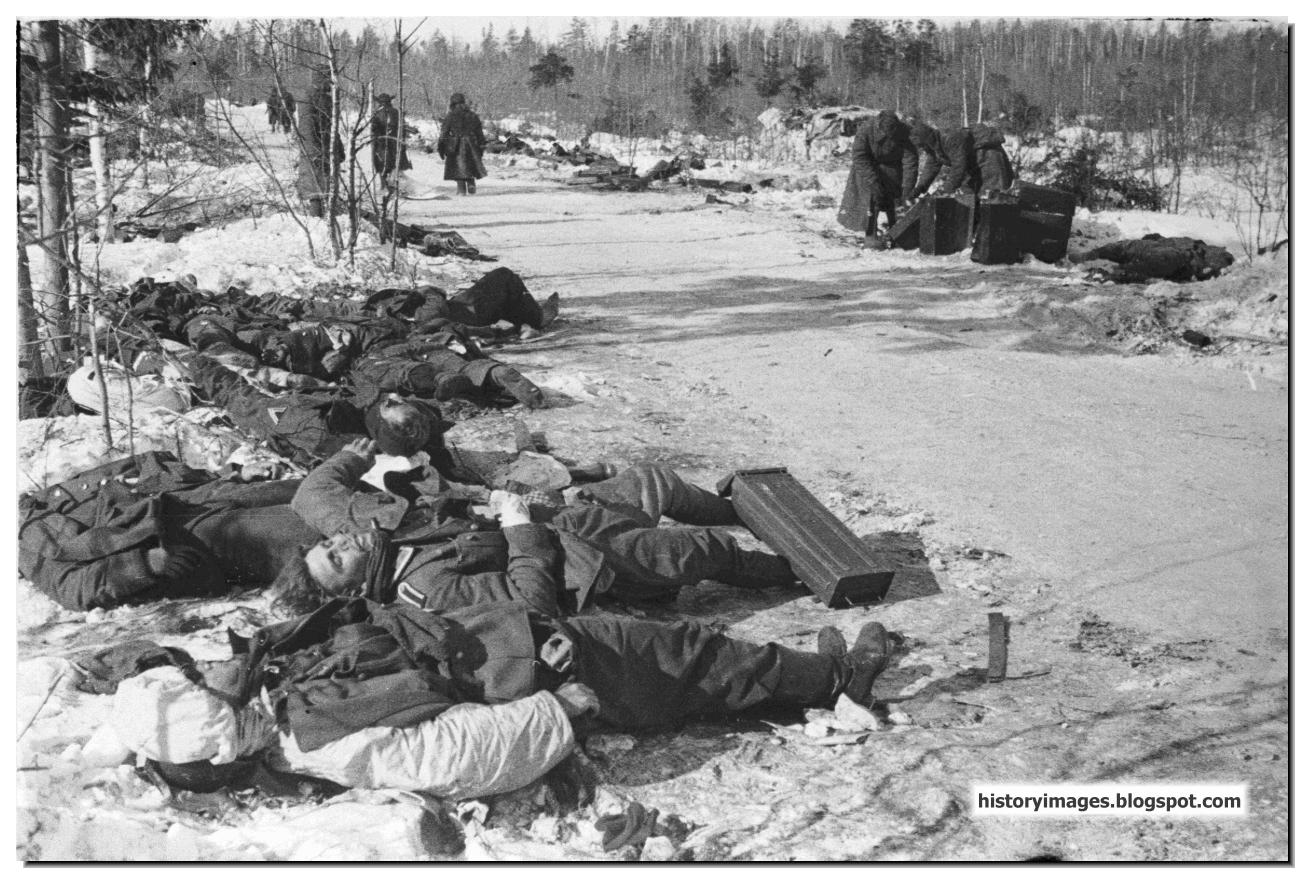
Bodies of German soldiers at the Leningrad front.


Russian civilians killed by German artillery fire. Leningrad. 1943.


Berlin defeated and destroyed. 1945


Killed by the Russians


A dejected Albert Speer after he inspected the damage to a metal plant in 1944 by Allied bombings


Mnay German soldiers were massacred at Korsun in 1944. Stalin demanded the Speedy "Liquidation" of the German Forces Trapped at Korsun before relief Could arrive. General Werner Stemmermann and his Remaining units Determined on a Final breakout. At 0200 hours on January 7 February, as a blizzard raged, Stemmermann's Troops Their finished last supplies and Destroyed guns and lorries, Leaving scenes like this one. There was no place in the columns for the wounded, Who Were killed where They Lay. As the German column moved into open Country, Soviet tanks charged straight into it and Cossacks hunted down and massacred fleeing Germans


Battle of Tarawa. A very bloody battle. Bodies of dead Marines litter the beach after the battle. Tarawa is an atoll located approximately 2,500 miles southwest of Hawaii. It consists of a series of coral islets that stretch through the ocean in a hook-like fashion. The military importance of Tarawa lay in its strategic location at the gateway of the US drive through the central Pacific towards the Philippines. The largest of Tarawa's islets is Betio measuring less than 3 miles in length and 1/2 mile in width. Here, the Japanese built an airstrip defended by 4,700 troops dug into a labyrinth of pillboxes and bunkers interconnected by tunnels and defended by wire and mines. The task of dislodging this force fell to the Marines of the 2nd Division. The resulting struggle produced one of the fiercest and bloodiest battles in Marine Corps. History The landings began on November 20 and immediately ran into trouble. Coming in at low tide, the assault boats were forced to disgorge their men far from shore. Wading through waist-deep water over piercing, razor-sharp coral, many were cut down by merciless enemy gunfire yards from the beach. Those who made it ashore huddled in the sand, hemmed in by the sea to one side and the Japanese to the other. The next morning, reinforcements made the same perilous journey bringing with them tanks and artillery. By the end of the day the Marines were able to break out from the beach to the inland. The fierce combat continued for another two days. The cost of victory was high for the Marines who suffered nearly 3,000 casualties. The toll was even higher for the Japanese. Of the 4,700 defenders, only 17 survived. Their willingness to fight to the last man foreshadowed the fierceness of the battles to come.

Dead German soldiers at Breslau. 1945. Breslau was turned into a fortress and there was fierce fighting in the last days of the war. Karl Hanke the ruthless Nazi Gauleiter adopted very hard tactics to keep his men fighting and Breslau held out till May 6, 1945. Not only because of Soviet aerial and artillery bombardment, but also as a result of the self-destructive actions of the SS and the NSDAP, 80 to 90 per cent of Breslau was destroyed . . . . after the Soviet capture of the Gandauer airfield, the Wehrmacht destroyed many houses and three churches to build a provisional airstrip 200 to 400 meters wide and two kilometers long.

Two Frenchwomen walk pass a dead German soldier in Cherbourg France. 1944

Winter 1941. Battle Of Moscow. Many German soldiers froze to death in the harsh Russian winter just because Hitler thought he would defeat the Russians before the winter set in.

Russia. These dead German soldiers await burial. The local Russians are digging the graves.

Share this PostPin ThisShare on TumblrShare on Google PlusEmail This

You Might Like These....

Search This Site

Popular Articles On This Site

More History Sites

Illustrated History

A Lousy Journalist?

A Lousy Journalist?
"Those who do not remember the past are condemned to repeat it."
-- George Santayana


History Quotes

May 1945 - If hell on earth existed, than it existed in Prague after May the 5th. 1945. Old men, women and children were beaten to death and maimed. Rapes, barbaric cruelties, horror-scenarios of hellish proportions - here they had been let lose.

- Ludek Pachmann, Czech Chess-Grand Master and publicist, forty years after the fact.

Copyright Issue

All the images on this site have been uploaded from the internet. Their copyrights lie with the respective owners.

If inadvertently any copy-righted material is published on this site, the owners of the material may contact us at balri24@gmail.com. We will remove the relevant portion immediately

Quotes

"History is a guide to navigation in perilous times. History is who we are and why we are the way we are."
-- DAVID C. MCCULLOUGH

History, despite its wrenching pain, cannot be unlived, but if faced with courage, need not be lived again.
-- MARY ANGELOU

Quotes

HISTORY, n. An account mostly false, of events mostly unimportant, which are brought about by rulers mostly knaves, and soldiers mostly fools.
-- Ambrose Bierce

We learn from history that we learn nothing from history.
-- GEORGE BERNARD SHAW

Quotes

"I have but one lamp by which my feet are guided, and that is the lamp of experience. I know no way of judging of the future but by the past."
--EDWARD GIBBON

"Patriotism ruins history."
-- GOETHE

Snippets from History

This short but important battle played a key role in the decision to use atomic bombs when attacking Hiroshima and Nagasaki. The battle showed just how far Japanese troops would go to defend their country.


Snippets From History

Paulus didn't give the order to 6th Army to surrender, but his troops no longer had much fight left in them. Resistance faded out over the next two days, with the last die-hards finally calling it quits. One Red Army colonel shouted at a group of prisoners, waving at the ruins all around them: "That's how Berlin is going to look!
"


Quotes

History is Philosophy teaching by examples.
-- THUCYDIDES

Quotes

"Those who cannot learn from history are doomed to repeat it."
-- George Santayana

Points to Ponder: Why Is China Unstable?

The aim of individuals in any society is money and power. Societies that give equal chance to all its members to get them will be the most stable. That is why democracies are more stable than other systems of governance.

China after Deng's reform gave the chance to get rich but power is in the hands of an elite; the Communist Party of China. Membership to the party is at the whims of the local party bosses. This leaves out many people who crave political power dissatisfied and disgruntled. There in lies the roots of instability. The Party suppressed these demands once at Tiananmen in 1989. But force is hardly the way to deal with things like these.

READ MORE: Tiananmen Square Massacre