This site may load slowly at times because of the numerous images. Please reload the page if some of the images do not appear. Thank you.

Search This Site

Russian Brutality: Massacres By Russian Soldiers During WW2

The eastern front was a hard place to be in. If the SS and gestapo did evil things in Russia, the Russian soldiers were no angels too. Here are some instances where German soldiers were massacred by the Russians. The Russians killed soldiers of other nations too. And we do not mention here the mass rapes in Berlin which started in April 1945.


KATYN FOREST (Smolensk, 1939-40)

In 1939, during the Russian invasion of Poland, some 14,500 Polish officers were captured and interned in three P.O.W. camps in the Soviet Union. The next time the world heard of these prisoners was a news broadcast on April 13, 1943, from Radio Berlin. It stated that the German Army had discovered mass graves at Katyn, 18 kilometres north-west of Smolensk, near the village of Gneizdovo and containing the bodies of Polish officers. Eight graves were opened and 4,253 bodies exhumed.


VIDEO: KATYN: PART 1


KATYN: PART 2


Katyn Forest massacre


All were dressed in Polish uniforms, with badges of rank and medals intact. No watches or rings were found on the corpses. It was established that the bodies were of Polish officers from the camp at Kozielsk, situated in the grounds of a former Monastery, near Orel. Two other camps, at Starobielsk (3,891 men) and at Ostashkov (6,311 men) were wound up and closed in the first days of April, 1940. Whatever happened to these 10,000 odd officers has never been established. They were never seen alive again. From evidence obtained after the war, all prisoners of Kozielsk camp were shot by Stalin's NKVD.


Red Army kills polish officers in the head

On April 13, 1990, fifty years after the massacre, the USSR for the first time admitted its responsibility for the murders. The whole controversy was finally laid to rest when Boris Yeltsin, handed over the secret files on Katyn to the Polish president, Lech Walesa, on October 14, 1992. In May 1992, in a wood near Kharkov, a Russian private investigation team discovered a mass grave containing 3,891 bodies of Polish officers from the camp at Starobielsk in the Ukraine. In June of that year, Soviet authorities discovered 30 mass graves at Miednoje, one hundred miles north-west of Moscow. They contained the remains of 6,287 Polish prisoners from the Ostashkov island camp on Lake Seliguer. Before the massacre, 245 officers from Kozielsk, 79 from Starobielsk and 124 from the camp at Ostashkor , were transferred, for no apparent reason, to a camp at Pavlishchev Bor, a hundred miles north-west of the Kozielsk camp. These 448 officers proved to be the only survivors of the Katyn massacre. KGB files state that 21,857 Poles were shot as a result of Stalin's order. In other parts of the Katyn Forest, other graves were discovered containing the bodies of Russian political prisoners who were executed in pre-war days by the NKVD. It seems that the Katyn Forest was the main execution site for Stalin’s secret police. (Not to be confused with the Khatyn murder site near Minsk) All mention of the Katyn atrocity has been removed from Soviet history textbooks.


VIDEO


MURDER AT BRONIKI, UKRAINE

On July 1st 1941, around 180 German soldiers of the 2nd and 6th Infantry Regiments and the 5th Artillery Regiment were taken prisoner by the Red Army in the town of Broniki. Most were suffering from battle wounds. Next day, the 2nd of July, advancing Wehrmacht troops discovered 153 bodies in a clover field near the town. All had been brutally murdered. According to the twelve survivors of the massacre, they were taken to the field just off the main road and forced to undress. All valuables such as money, rings, watches as well as their uniforms, shirts and shoes were stolen. Standing there naked, the prisoners were then fired upon by machine guns and automatic rifles. A few managed to escape by fleeing to the nearby woods. Similar reports from other regiments gave rise to the suspicion that the Soviets, in the early stages of the war, were not taking any prisoners. There was a division order, according to which every Russian soldier who shoots twenty German soldiers, received a three day leave pass to go home. He also was decorated and raised in rank.


THE GRISCHINO MASSACRE (February 18, 1943)


The area of Grischino lies to the north-west of Stalino (now Donets) an important industrial region in the Ukraine. Occupied by German forces, it was recaptured by a Soviet armored division and again recaptured by the German 7th Armored Division during a counteroffensive in February, 1943. What they found was the bodies of 406 German soldiers, (POWs) 58 were members of the Todt Organization, 89 Italian soldiers, 9 Romanian soldiers, 4 Hungarian soldiers and some civilian workers, Ukrainian volunteers and German nurses. A total of 596 souls had been killed. Most were shot after being dragged from their hiding places in cellars. Many of the bodies were horribly mutilated, ears and noses cut off and genital organs amputated and stuffed into their mouths. Breasts of some of the nurses were cut off, the women being brutally raped. In the cellar of the main train station around 120 Germans were herded into a large storage room and then mowed down with machine guns. It was realized that the Russians had killed every single German they had found there. As with most massacres, there were survivors and in this case, civilian witnesses.

During the week of 22/29 June, 1941, thousands of Ukrainian and Polish political prisoners were murdered in their cells by the Soviet NKVD (KGB). The Soviets' hurried retreat had tragic consequences for all political prisoners in the jails of Western Ukraine. Soon after the German attack on the Soviet Union, the retreating Soviets had no time to care for their prisoners locked up in prisons in the Ukraine, so they were simply killed. In some cities the whole prison was set on fire and the helpless prisoners burned to death. In Lutsk, 2,800 out of the 4000 inmates in the NKVD prison, were murdered. When the German 49th Army Corps occupied the Polish-Ukrainian city of Lvov, (now Limberg) around 2,400 dead bodies were found by German troops in the NKVD prison. Some were killed by hand-grenades thrown into their cells, most were killed by a shot in the neck. In the cellars of the Brygidky Prison on Palczymska Street, 423 bodies were recovered. Hundreds more were piled up in the courtyard. In the military prison at Samarstinov, which had been set on fire, 460 charred bodies were found, many showing signs of brutal torture. In the cellars, bodies were piled up layer upon layer almost to the ceiling. Owing to the stench of the decomposing corpses, the German commander of Lvov ordered all doors to the cellars bricked up after the bodies were covered with lime. On June 26-27, 1941, some 520 Ukrainians were shot at Sambor, and at Zlochev, another 700, including the entire local intelligentsia, were arrested and shot on July 16, 1941. At Kremenets, between 100 and 150 were killed and when the bodies were recovered some bodies were without skin, having been thrown into boiling water.

Altogether, in the Ukraine, around 10,000 Ukrainian and Polish political prisoners were killed in their prisons. It is a sad fact that many members of the NKVD execution squads in the Ukraine, were Jewish collaborators. These collaborators were hated by other Jews more than the German SS. (A memorial plaque at the former headquarters of the NKVD/KGB in Simferpol, Ukraine, is engraved with the names of thirty NKVD agents who gave their lives in the Great Patriotic War (the Soviet name for World War II). The amazing thing is that all thirty names are Jewish! About half a million Jews served in the Red Army and approximately 200,000 were killed. A total of 160,000 Jewish soldiers were decorated with Soviet awards, 145 receiving the highest Soviet award, 'Hero of the Soviet Union'. Two Jewish women were also awarded this honour. (Many Soviet soldiers, after capture, joined the Waffen SS. The 30th SS Division was composed of such troops)


ATROCITY AT FEODOSIA (December 29, 1941)

On the shores of the Black Sea, on the Crimean Peninsula, stands the port city of Feodosia. On the 3rd of November the city was captured by the German 46th and 170th Infantry Divisions. As the attack on Sevastopol was about to take place, most of the German forces were withdrawn to concentrate on the forthcoming battle. Left behind in the city were a small detachment of troops and all the wounded soldiers convalescing in the city's hospitals. On the afternoon of December 29, the city was bombarded by the Soviet Black Sea Fleet and a landing was made by Soviet marines followed by infantry. On the 18th of January, 1942, after their failure to capture Sevastopol, the German Wehrmacht was able to return and recapture Feodosia. They found that most of the German military personnel had been murdered. Wounded soldiers had been thrown out of the windows of the hospital to make room for Russian wounded. Water was then poured on the near dead bodies and then left to freeze. On the beach, piles of bodies were found where they were thrown from a wall several metres high after being beaten and mutilated, their bodies left in the surf so that the sea water froze and covered them with a sheet of ice. There were some twelve survivors who had hidden in cellars when the Russian troops arrived. Their testimony before a German court of inquiry confirmed that some 160 wounded soldiers were liquidated this way.


THE KORSUN SLAUGHTER (February 16-17, 1944)

During the freezing cold night of February 16, five divisions of General Hube's 1st SS Panzer Army, (54,000 men) including the 5th SS Division Viking and the Belgian Volunteer Brigade Wallonie, made a last desperate bid to break out of the Russian encirclement around the towns of Korsun and Shandrerovka in the lower Dnieper south-west of Kiev (Kyiv). At 4am, elements of the 8th Army formed up into two marching columns of around 14,000 men each and flocked into two parallel ravines in the surrounding countryside, and where the two ravines met, the troops, now in complete disorder, then emerged into open country and headed out towards the town of Lysyanka.


Soviet soldiers kill german soldiers


There, disaster struck as troops of the 2nd Ukrainian Front, under General Konev, were waiting. Soon after 6am, the slaughter began. Soviet tanks drove into the two German columns crushing hundreds under their tracks. Fleeing in panic, the troops were then bombed and shelled before being confronted by units of Cossack cavalry who started hacking them to pieces with their sabres, There was no time to take prisoners and in the short space of three hours around 20,000 German soldiers lay dead, their bodies later dumped in holes dug in the ground. The hundreds of wounded and medical personnel left behind were butchered by the Cossacks. Only a few officers survived, most had fled the scene by plane some days before. (Russian sources put the number of dead during the two weeks of fighting at over 70,000) To reach Lysyanka the troops had first to cross the raging Gniloy-Tikich river. Reaching the opposite side many were transformed into blocks of ice their uniforms frozen to their bodies. About eight thousand others, who had fled the scene and were hiding in the woods, were rounded up during the next few days and taken prisoner. For this great victory, General Konev was awarded the title 'Marshal of the Soviet Union'.


--------------------------
During the fighting in Norway and Finland, the SS Gebirgsdivision 'Nord', was opposing the Russian forces. Very few SS men were taken prisoners by the Red Army, most were shot immediately. A report on Operation No 11 from the Soviet 26th Division states: 'The enemy left approximately 400 dead on the battlefield. Some 80 Germans had surrendered and were executed'.

In the notes found on a Soviet doctor after he was captured, he had written: 'All POWs who belonged to the German Army were executed during the operations near Odessa'.

Soviet archives reveal the following: 'July 7, 1943, the enemy suffered great losses...we did not take any prisoners, they were all liquidated'.


-------------------------------
Waffen ss soldiers tortured killed

This photo shows one of 34 german soldiers of 9th SS-Panzer-Division "Hohenstaufen" that were captured by the Red Army in April 1944 in the ukrainian village of Kalasantovka. The mutilated bodies were found by their comrades during the german counter attack on the near-by town of Ternopil. A german eyewitness: "That's not the way soldiers are supposed to act. The hands and the feet of the dead were bound with the ropes of their own tentpieces. Partially the trousers were pulled down and genitals severed. With some the eyes were stabbed, ears and tongue cut off. Furthermore their own bayonet was rammed into the stomach from the downside. Dogtags and other ID's were removed to avoid an identification of the dead. Fortunately most of them had their last names sewn on the inside of their uniform pieces so that a list of the victims could be compiled. However this list was lost later on so that these 34 soldiers are considered officially as "Missing in Action".

Source: ww2incolor


-----------------------------

RUSSIAN BRUTALITY IN KOENIGSBURG 1945

During the last months of the war, the ancient German city of Königsberg in East Prussia held out as a strongly defended urban fortress. After repeated attack and siege by the Red Army, it finally surrendered in early April 1945. Soviet troops then ravished the civilian population. The people were beaten, robbed, killed and, if female, raped. The rape victims included nuns. Even hospital patients were robbed of their possessions. Bunkers and shelters, packed with terrified people huddling inside, were torched with flame-throwers. About 40,000 of the city’s population were killed, or took their own lives to escape the horrors, and the remaining 73,000 Germans were brutally deported.

IHR.ORG


------------------------------

In October 1945, a New York Daily News report from occupied Berlin told readers:


 “In the windswept courtyard of the Stettiner Bahnof [rail station], a cohort of German refugees, part of 12 million to 19 million dispossessed in East Prussia and Silesia, sat in groups under a driving rain and told the story of their miserable pilgrimage, during which more than 25 percent died by the roadside, and the remainder were so starved they scarcely had strength to walk … 

 “A nurse from Stettin, a young, good-looking blond, told how her father had been stabbed to death by Russian soldiers who, after raping her mother and sister, tried to break into her own room. She escaped and hid in a haystack with four other women for four days … 

 “On the train to Berlin she was pillaged once by Russian troops and twice by Poles. Women who resisted were shot dead, she said, and on one occasion she saw a guard take an infant by the legs and crush its skull against a post because the child cried while the guard was raping its mother. 

 “An old peasant from Silesia said ... victims were robbed of everything they had, even their shoes. Infants were robbed of their swaddling clothes so that they froze to death. All the healthy girls and women, even those 65 years of age, were raped in the train and then robbed, the peasant said.”

Share this PostPin ThisShare on TumblrShare on Google PlusEmail This

The Russians At Stalingrad: A Pictorial

"In Stalingrad, humanity saw the dawn of victory over Fascism"
Russian general Chuikov.

“Animals flee this hell; the hardest stones cannot bear it for long; only men endure,” wrote a German soldier, summing up his experience of the battle.

Stalingrad wasn’t just a battle; it ranks among the greatest episodes of human history. The scale of fighting was almost Homeric. There was bravery, there was brutality and there was cannibalism.

Courage, toughness and weapons were peripheral factors in the Battle of Stalingrad. It was the tactical superiority of the Russian soldier in a range of environments that was the key to the Russian victory.
http://indrus.in/blogs/2013/02/06/stalingrad_what_happened_inside_the_cauldron_22125.html

However, the victory at Stalingrad was not simply a matter of enormous human sacrifice. It not only required winning the production battle with Nazi Germany, the Red Army also had to master the tactics of urban warfare.
--------------------------------
In Britain and the US, the Soviet contribution to Hitler’s defeat has long been played down. Central in this lack of recognition was not only the sacrifice made by the people of the Soviet Union, but also how they defied the misleadership and repression of Stalin and his machine.

-----------------------------

Chuikov’s forces were left to face the vastly bigger German forces virtually on their own. Meanwhile Zhukov and Vasilevsky were preparing a wider encirclement of the Paulus’ army, while Chuikov’s forces acted as “bait”.


When it comes to Stalingrad, one generally wants to see the images of German soldiers. The reason is obvious. They lost. Most died in battle and in the ensuing captivity. We get a sense of sadness, of ghoulish fascination.

Below are some images of Soviet soldiers at Stalingrad. We have avoided the more well known pictures. We have also eschewed the " Soviet-propaganda-grinning-confident-soldiers" images.

What the Russians did at Stalingrad deserves our deepest admiration. Withstanding the full might of the Wehrmacht and then destroying the German Sixth Army was no mean achievement. This is not so well known in the English speaking world because the Russians were never good at trumpeting themselves as say the Americans and British are.

Any serious student of history knows that Chuikov, Rodimtsev, Zhukov and Khruschev are names that rang the death knell of Nazi Germany. Funnily more people in the world have heard of the names of Eisenhower, Montgomery, Bradley then the names mentioned above.
--------------------------
At this desperate hour, they could hear the Germans shout from their trenches: “Russ, skoro bul-bul u Volga.” (“Russians, you'll soon be blowing bubbles in the Volga.”).


People of Stalingrad flee after the first German aerial bombardments. On the left is a Russian anti-aircraft gun.

This is what German Field Marshal Kleist had to say of the Russians....


A German sniper apprehended by Soviet soldiers. Stalingrad. 1942. Looks like the poor guy has been roughly handled. Stalingrad was a tough place to be in in late 1942.

VIDEO: STALINGRAD PART 1


“In order to defeat the Russian soldier, you must kill him. Then bayonet him. And then shoot the bastard – and only then you can be sure of your victory.” When Frederick the Great made that statement in the latter half of the 18th century, he was hardly influenced by Bolshevik propaganda. As one of the foremost generals of his time, the Prussian ruler’s assessment that the Russian soldier was the toughest was based on his battlefield observations of European armies and individual soldiers.

 Russian soldiers fire the 50 mm mortars at German positions. September-October 1942.


It was Stalingrad that reinforced the image of the tough Russian. General Vasilii Chuikov, whose 62nd Army was tasked with the defence of Stalingrad, writes in his memoirs, The Story of the Battle for Stalingrad, about the tough new guardsmen the Russians introduced into the battlefield: “These were really guardsmen. All of them were young and tall, and healthy, many of them in paratroop uniform, with knives and daggers tucked into their belts. They went in for bayonet charges, and would throw a dead German over their shoulder like a sack of straw. For house-to-house fighting, there was no one quite like them. They would attack in small groups, and, breaking into houses and cellars, they would use their knives and daggers.”


VIDEO: STALINGRAD: PART 2

 A Russian doctor operates in Stalingrad


The stiff resistance offered by Russian soldiers, despite the complete lack of preparedness of their forward units in 1941-42, had surprised the Germans. In hopelessly outnumbered and outgunned battles – at the fortress of Brest-Litovsk on the western frontier, in Sevastopol, Odessa and Tula – the Soviets had displayed astonishing resistance that took a heavy toll on the German Army. “In retrospect, it is difficult to imagine Stalingrad as anything but a death trap for the Germans,” writes David Stone, professor of military history, Kansas State University, in the Journal of Slavic Studies.

The braves nurses carry the wounded from the factory shop at Stalingrad.


As the Russians fought off the Germans, the 62nd Army’s command post, which was located near some oil installations, were set ablaze by German bombers. The burning oil poured across Chuikov’s trenches.

“At first we almost lost our heads,” Chuikov writes. “What were we to do? Then my chief of staff, General Krylov, gave the order: “Sit tight. Stay in the undamaged dugouts and keep up radio communications with the troops.”

The fire went on for several days, with nobody to douse it as all of Chuikov’s troops, including his engineers, were fighting the Germans. In the remaining dugouts, often under enemy fire, and with a massive blaze around them, Chuikov and his commanders somehow clung on to their bridgeheads. “We did not sleep for several days and nights,” he writes.

Stalingrad after the battle in 1943. (Click to enlarge image)


Soviet soldiers of the 308th Rifle division rush forward in the Barrikady factory. They are armed with the PPSh machine-gun which was ideal for close combat but inaccurate over 50 metres.


“The 14th of October marked the beginning of a battle unequalled in its cruelty and ferocity throughout the whole of the Stalingrad fighting,” writes Chuikov. “Three infantry and two panzer divisions were hurled against us along a five-km. front... There were three thousand German air sorties that day. They bombed and stormed our troops without a moment's respite. The German guns and mortars showered on us shells and bombs from morning till night. It was a sunny day, but owing to the smoke and soot, visibility was reduced to 100 yards. Our dugouts were shaking and crumbling up like a house of cards.

“By October 30 we began to feel that we were winning the battle. It was clear that Paulus was no longer able to repeat his October 14 offensive which brought us to the brink of catastrophe.

But it was not over yet. On November 11, the Germans launched their last major attack on the defenders of Stalingrad. Both sides knew it was now or never. In Chuikov’s words, “We fought for every brick and stone, for every yard of the Stalingrad earth.”

Russian soldiers at the Red October factory. 1942 (Click to enlarge image)


September 1942. The Soviet 284th Rifle Division after landing on the shores of Volga in Stalingrad. Famous sniper Vasily Zaitsev belonged to this division.


A Soviet storm group move cautiously amongst the ruins of Stalingrad


The Russians soon adapted brilliantly to the rigours of urban warfare. “Contrary to a picture drawn from German sources, Stalingrad shows the Soviet Army as analytical and innovative, understanding technology and employing resources effectively, and relying heavily on the initiative and flexibility of individual soldiers and junior officers,” writes Stone.

“The Soviets proved to be highly skilled at urban warfare. Given that fighting in cities requires great initiative and improvisation on the part of individual soldiers and junior officers, the Soviet victory further undermines the outdated conventional wisdom of stolid and faceless Russian soldiers.”

For instance, the Russian defenders faced the greatest threat from the Luftwaffe. They also observed that the Germans were not good at precision bombing. Chuikov, therefore, devised a tactic whereby the gap between the Germans and the Russians never exceeded “the distance of a hand-grenade throw”. This kept the Russian frontlines more or less immune from air attack.

Soviet officers monitor the enemy from the artillery command post of the 138th Infantry Division.


Two other factors worked very well for the Russians – artillery and snipers. The powerful fire of the guns and katyusha multiple rocket launchers from the east bank of the Volga caused havoc among German troop concentrations. In one instance, an entire German battalion was wiped out by one katyusha salvo.

Stalingrad was also the origin of the legend of sniper Vasili Zaitsev. A soldier with the Russian 248th Division from Siberia, he was so skilful a shot that in one 10-day period killed 40 Germans, each with a single shot.

Zaitsev was credited with 225 verified kills, 11 of them snipers. The snipers became a fearsome force within the Russian Army, and the soldiers he trained alone notched up 6000 confirmed kills, planting the seeds of panic within the German Army.

August 1942. Red Army ferries men and supplies across the river Volga which were continuously hammered by the Luftwaffe. (Click to enlarge image)


German war memoirs often blame the Wehrmacht’s difficulties on the “Russian winter”. Many Western historians have lapped up such lies perhaps in a bid to take some off the shine from the Russian victory. 

In fact, the Germans dispatches if studied impartially would shed some light on the role played by winter in the outcome of the war. For instance, General Heinz Guderian has gone on record, saying that in many sectors “there was no possibility of using motorised troops until the frost set in”.

Alexander Werth says in Russia at War – 1941-45: “Guderian’s argument that rain and mud interfered with the success of the first German offensive against Moscow seems futile, since it affected the Russians as much as the Germans; besides, Guderian himself admits it was the defence put up by the Russians, and not the mud that stopped him from capturing Tula, this key position on the way to Moscow.”

Red Army soldiers of the 62nd Army in huts on the bank of the River Volga. 1942

In the larger war theatre, the defenders of Stalingrad were performing a role that the Russian brass wanted them to do – they were occupying German attention, while the buildup of troops on the German Sixth Army’s flanks continued. Unknown to the Germans, a new army group called the Southwest Front under Lieutenant General Nikolai Vatutin was established. As Chuikov said, “Time is blood.”

The Russian counterattack when it came broke the exhausted Germans’ back. American journalist Henry Shapiro gave a vivid account of that attack: “The steppe was a fantastic sight; it was full of dead horses, while some horses were only half dead, standing on three legs and shaking the broken one. It was pathetic, 10,000 horses had been killed in the Russian breakthrough. The whole steppe was strewn with these dead horses, and wrecked guns and tanks and trucks and half-tracks, and no end of Romanian and German corpses.”

Residents of Stalingrad cooking amongst the ruins of what once were their homes. Handiwork of the Luftwaffe. Richthofen and the German planners did not forsee that by bombing Stalingrad to bits in August and September 1942 they were digging the grave of the German Sixth Army.

Russian women pilots with their light U-2 plane in the background. These planes made of wood carried 6 bombs of 50 kg each. The women pilots would fly over German positions at night and drop the bombs. The light plane hardly made any noise. The Germans called these women pilots "night witches." Many got the Hero of the Soviet Union after the war

Stalin’s leadership during the war was one of the most enduring myths within the former Soviet Union. Even in today’s Russia, those ready to criticise Stalin’s purges still find it difficult to accept that his wartime role was so disastrous. Chief amongst the myths was that Stalingrad could never have fallen. But the truth was that things had got so bad that, in the words of one veteran, Gamlet Dallakian, “there was virtually nobody to defend the city”. But, he said, “it was forbidden to admit that Stalingrad could have fallen – I would have been arrested. … During the defensive period of the battle, the idea that our soldiers never lost faith in an eventual victory was a propaganda myth.”


Soviet soldiers firing anti-aircraft gun at German aircraft at Stalingrad. 1942


As the main landing area near the center of Stalingrad came under increasing pressure an alternate landing site on the Zaitsevski island was built. Here Russians soldiers build a pontoon bridge connecting the island with eastern Stalingrad under German fire.

THE VITAL ROLE OF CHUIKOV


Things changed dramatically under Chuikov’s leadership when he introduced a unique spirit of equality and unity within the army.


Beevor describes Chuikov mainly as “ruthless” and holds him responsible for the execution of thousands of Soviet soldiers at Stalingrad. Historian Paul Overy and Chuikov’s own soldiers disagree and newly released NKVD (Stalin’s secret police) documents have borne them out. The execution rate for cowardice was far lower within the 62nd Army than for the Stalingrad Front as a whole.

Chuikov made an acute study of what gave his enemies superiority in order to find ways of taking them by surprise. He continued to seek new ways of fighting, running military exercises for his men which were significant through their novelty. In the words of his tank commander at Stalingrad:

“He was always seeking new approaches… demanding that we get really, really close to the firing line, and immediately penetrate the enemy trenches, not letting them recover from the artillery shelling. It was a novelty at the time, and not everyone approved of it. But how wonderfully it worked at Stalingrad.”

Chuikov’s distrust of blueprints, his flexibility and fresh approach psychologically gave the defenders “reason to hope again”. Chuikov made up for his army’s weaknesses by encouraging a spirit of combat initiative, introducing new units such as small storm groups. While being tough on discipline, he also trusted his soldiers, thereby again transforming morale. He led from the front, breaking regulations by having his HQ extremely close to the enemy’s lines.

Without these skills and qualities and those of other leaders like Alexander Rodimtsev, the 36-year-old commander of the 13th Guards Rifle Division, the desperate odds faced by the defenders between 13 and 14 September 1942 in the fight for the Central Railway Station and control of Mamayev Kurgan would have meant certain defeat. Indeed, Rodimtsev’s guards took almost 100% casualties crossing the Volga to come to the rescue of the 62nd Army.


When the Germans took control of the famous Mamayev Kurgan hill, which was seen as the key to the city, the 62nd Army only had enough ammunition for one day’s fighting in the city, while the 6th Army under General Friedrich Paulus expended 23 million rifle rounds, 750,000 mortar shells, 685,000 tank and infantry artillery shells, plus 178,000 hand grenades.

That day, the NKVD, who had been appointed by headquarters to be in charge both as soldiers and police, were unable to withstand the German offensive. When Chuikov arrived he challenged General Yeremenko’s (who led the counter-attack on Stalingrad) orders, Jones writes, “insisting that the NKVD forces be subordinated to his own authority”. The NKVD colonel Sarayev backed down. The NKDV’s “blocking detachments” responsible for preventing retreat, sometimes by shooting their own side, were now under the divisional commander’s authority.


Chuikov’s original idea of a “storm troop group” took hold amongst the soldiers and became increasingly popular. It relied on taking the enemy by surprise by preying on the German’s dislike of night fighting and close combat. Through short bursts of concentrated hand-to-hand fighting at which Stalingrad’s defenders became increasingly skilled, fighting for the city on a house-to-house – or rather ruin-to-ruin – basis. Chuikov, Rodimstev and defenders like Jacob Pavlov (of the famous Pavlov house), Georgi Potanksi, Anton Dragan, and a Captain Naumov developed these new ways of fighting under conditions of absolute desperation. They made key positions like Pavlov’s house into part of an integrated defence system using artillery spotters and supporting artillery fire. In this decentralised network of fighters, rank-and-file soldiers began to feel their own strength and influence in changing the course of history. Chuikov had coined a new slogan – “Every man a fortress”.


http://www.aworldtowin.net/reviews/Stalingrad.html


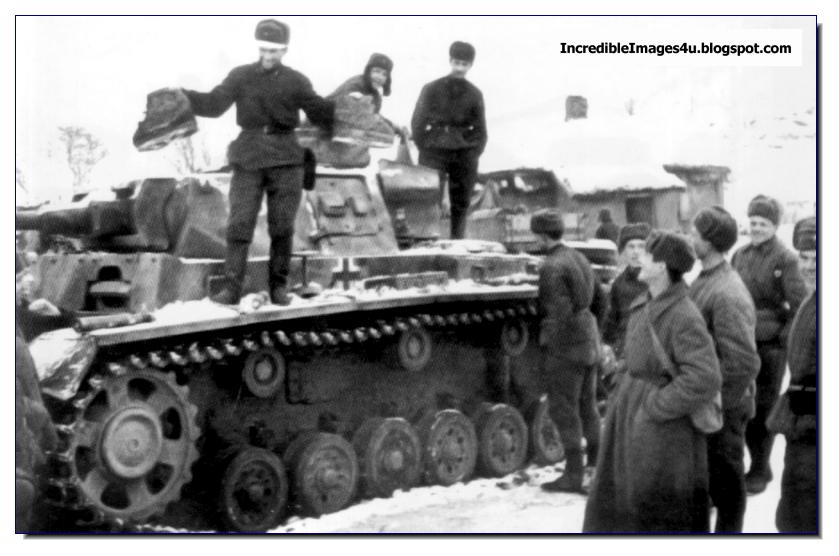
Soviet soldiers atop a German tank displaying the home made boots (made from paper) used by desperate German soldiers. Later stages of the battle when the encircled Germans were in dire straits


Street fighting in Stalingrad (Click to enlarge image)


The tough hero. Alexander Rodimtsev. With his tough Siberian men from the 13th Guards Division (Click to enlarge image)

WHO WAS ALEXANDER RODIMTSEV?
During the course of the Second World War, he is best remembered for his role in the Battle of Stalingrad, where he brilliantly commanded the 13th Guards Rifle Division which earned him his second order of Hero of the Soviet Union. The division was charged to hold the Germans between Mamaev Kurgan and Tsaritsa Gorge, which his outnumbered and outgunned force successfully did. Rodimtsev was vastly popular with his troops and was well known for his bravery.

Soviet machine-gunners change position. 1942 (Click to enlarge image)


Here from a Russian account is how the fighting went: "At a narrow window in the semi-basement we set up the heavy machine gun, with our emergency supply of ammunition—the last belt of cartridges I had decided to use at the most critical moment. Two groups, six in each, went up to the third floor and the attic. Their job was to break down walls and to prepare lumps of stone and beams to throw at the Germans. A place for the seriously wounded was set aside in the basement...."

After five days the basement held twenty-eight seriously wounded men. Only twelve men were still able to fight. The only food was a few pounds of scorched grain. There was no water.


The German attacks stopped, but they kept up the fire from their heavy-caliber machine guns.

"The Germans attacked again. I ran upstairs with my men and could see their thin, blackened and strained faces, the bandages on their hands."

The nurse with the battalion, Lyuba Nestertenko, was dying with blood flowing from a wound in the chest. She tried to help bind up a man's wound, but she failed.

The German attack was beaten off. In the silence that gathered they could hear the fighting on Mamayev Hill and in the factory area.

"How could we help the men defending the city?" the commander of the battalion asked himself. "How could we divert from over there even a part of the enemy forces, which had stopped attacking our building?"

They decided to infuriate the Germans by raising a red flag over the building in defiance. But they had no red material. One soldier who was severely wounded took off his bloody undershirt, wiped his wound with it to get more blood, and handed it to the officer.

The Germans shouted through a megaphone: "Russians, surrender. You'll die just the same."

The red flag went up over the building.

"Bark, you dogs. We've still got a long time to live," shouted a Russian soldier.

Russian soldiers firing 120 mm mortars on German positions. 1942

Soviet soldiers walking towards Stalingrad. It is September 1942 and the Volga is not frozen yet
A German Messerschmitt pilot force landed in Stalingrad due to engine failure was arrested by the Russians. September 8, 1942. (Click to enlarge image)


Russian citizens leave their homes as the German bombs fall on Stalingrad


Soviet soldiers in a defensive position as the German assault begins on the outskirts of Stalingrad


A Stuka has just hit a Soviet boat crossing over to Stalingrad. Russian soldiers rush to help survivors swimming ashore. A pall of smoke hangs over the Volga.


A Soviet Storm Group climbs the stairs apprehensively in a building near the Red October factory. The Russians had to worry not only about the Germans but the poor state of the buildings rocked by bombs


Soviet reinforcements cross the River Volga into Stalingrad. September, 1942.


The Red Army put up hedgehog defenses in Stalingrad. August 1942


A Soviet soldier enjoys his much welcome daily quota of 100 gms of vodka from a German mess tin as his comrade looks on enviously


The Red Army attacks and captures the village of Spartanovka on the outskirts of Stalingrad. January 1, 1943. The Germans were so weak and exhausted that they did not have the strength to dig graves in the hard frozen ground for their dead.


Soviet soldiers of the 39th Guards rifle division at the "Red October" factory. January 1943.


Soviet soldiers in a German Ju-52 transport plane which crash landed in Stalingrad. November 1942


The deadly Soviet Katyusha rockets firing on German positions at night. The German soldiers hated them.


As the Sixth Army fought on in Stalingrad because of Hitler's fixation, the Soviet army as part of Operation Uranus starting encircling it. The Soviet tanks and army moved at night to avoid the prying eyes of the Luftwaffe.


Russian soldiers from the Don Front chasing retreating German soldiers into Stalingrad, pass by some dead Germans. Both sides treated the injured or surrendered with utmost brutality


Victory parade after the liberation of Stalingrad. 1943


The commander of the 13th Guards Division, which participated in the defense of Stalingrad, a Hero of the Soviet Union, Major General Rodimtsev near the staff dugout. Stalingrad, September 1942.


German planes at Stalingrad captured by the Russians. On the right the large aircraft - transport glider DFS 230, left - dive bomber Junkers Ju-87


Chuikov examines the rifle of Vasily Zaitsev as the famous Russian sniper looks on. January 1943.

RELATED


---------------------------------------------
Suggested Reading


STALINGRAD: How the Red Army Triumphed by MICHAEL JONES

Jones in his book gives an unbiased account of how the Russians defeated the Germans at Stalingrad in 1942-43.


Michael K. Jones's new history of Stalingrad offers a radical reinterpretation of the most famous battle of the WW2. Combining eyewitness testimony of Red Army fighters with fresh archive material, the book gives a dramatic insight into the thinking of the Russian command and the mood of the ordinary soldiers. He focuses on the story of the Russian 62nd Army, which began the campaign in utter demoralization, yet turned the tables on the powerful German 6th Army. He explains the Red Army's extraordinary performance using battle psychology, emphasizing the vital role of leadership, morale and motivation in a triumph that turned the course of the war.

While most would look to Beevor's "Stalingrad: The Fateful Siege" as a guide to the battle, I would tell them to not waste their time. Jones, constantly, proves how Beevor has misinterpreted the history of the battle in one way or another or rather propagated already established myths.

------------------------------------


STALINGRAD: Victory on the Volga (Images of War) By Nik Cornish

Many rare pictures from the battle of Stalingrad


I have the kindle edition and it is a very good, concise history of the battle with some very good pictures to accompany the text. If you had to only own one book on Stalingrad, this one is to brief, but for what it is, a book that primarily focused on images from Stalingrad, it is an excellent book.
A Reader

Share this PostPin ThisShare on TumblrShare on Google PlusEmail This

You Might Like These....

Search This Site

Popular Articles On This Site

More History Sites

Illustrated History

A Lousy Journalist?

A Lousy Journalist?
"Those who do not remember the past are condemned to repeat it."
-- George Santayana


History Quotes

May 1945 - If hell on earth existed, than it existed in Prague after May the 5th. 1945. Old men, women and children were beaten to death and maimed. Rapes, barbaric cruelties, horror-scenarios of hellish proportions - here they had been let lose.

- Ludek Pachmann, Czech Chess-Grand Master and publicist, forty years after the fact.

Copyright Issue

All the images on this site have been uploaded from the internet. Their copyrights lie with the respective owners.

If inadvertently any copy-righted material is published on this site, the owners of the material may contact us at balri24@gmail.com. We will remove the relevant portion immediately

Quotes

"History is a guide to navigation in perilous times. History is who we are and why we are the way we are."
-- DAVID C. MCCULLOUGH

History, despite its wrenching pain, cannot be unlived, but if faced with courage, need not be lived again.
-- MARY ANGELOU

Quotes

HISTORY, n. An account mostly false, of events mostly unimportant, which are brought about by rulers mostly knaves, and soldiers mostly fools.
-- Ambrose Bierce

We learn from history that we learn nothing from history.
-- GEORGE BERNARD SHAW

Quotes

"I have but one lamp by which my feet are guided, and that is the lamp of experience. I know no way of judging of the future but by the past."
--EDWARD GIBBON

"Patriotism ruins history."
-- GOETHE

Snippets from History

This short but important battle played a key role in the decision to use atomic bombs when attacking Hiroshima and Nagasaki. The battle showed just how far Japanese troops would go to defend their country.


Snippets From History

Paulus didn't give the order to 6th Army to surrender, but his troops no longer had much fight left in them. Resistance faded out over the next two days, with the last die-hards finally calling it quits. One Red Army colonel shouted at a group of prisoners, waving at the ruins all around them: "That's how Berlin is going to look!
"


Quotes

History is Philosophy teaching by examples.
-- THUCYDIDES

Quotes

"Those who cannot learn from history are doomed to repeat it."
-- George Santayana

Points to Ponder: Why Is China Unstable?

The aim of individuals in any society is money and power. Societies that give equal chance to all its members to get them will be the most stable. That is why democracies are more stable than other systems of governance.

China after Deng's reform gave the chance to get rich but power is in the hands of an elite; the Communist Party of China. Membership to the party is at the whims of the local party bosses. This leaves out many people who crave political power dissatisfied and disgruntled. There in lies the roots of instability. The Party suppressed these demands once at Tiananmen in 1989. But force is hardly the way to deal with things like these.

READ MORE: Tiananmen Square Massacre