This site may load slowly at times because of the numerous images. Please reload the page if some of the images do not appear. Thank you.

Search This Site

When Germans Hanged The First Soviet Partisans In 1941....

The war on the WW2 Eastern Front was Total War, Absolute War....Call it anything...It was brutal.

After the Germans swept through Soviet Union in 1941, partisans activity in the occupied territories started prompted by Moscow. The Germans considered the partisans a serious threat (Not without reason). On October 26, 1941, the first partisans were hanged in Minsk.

Here are the chilling images....

The whole execution was filmed by a photographer. Underground workers managed to obtain duplicate pictures, which, after the liberation of Minsk were handed over to the Soviet authorities. These photos featured at the Nuremberg Trials as a document of accusations against Nazi criminals.

The captured partisans are led in a public procession to the execution site

17 year Maria Bruskin being prepared

12 partisans were hanged in all

The board hanging from the neck reads (written in German and in Russian) "We  guerrillas fired on German troops"

Share this PostPin ThisShare on TumblrShare on Google PlusEmail This

OPERATION BAGRATION, 1944: It Broke The Back Of The German Army


A   GERMAN SOLDIER RECOUNTS THE HORROR

Berezina is quite a large river. By the end of that tragic day, all the water in the river was red with blood. Weakened or injured thousands drowned, not being able to cross it. There were thousands of people who could not swim and whose helpless bodies were swept away. Finally, the river bed was so littered with the bodies of men and horses, abandoned equipment, that when I came to the river bank, I saw a bloodcurdling fantastic view, that was probably a rarity even for the Eastern campaign. I managed to cross the river, almost without wetting my shoes, I stepped over the bodies of those who once terrified the whole of Europe. 


+ + + + + + + + + + + 


After moving to the other side, we went on without respite. I still remember the walk along the roads, rivers and endless forests, under constant threat of enemy fire. Russian fire was constantly on us. So our column continued to plod on, darting from side to side like drunken mad men.  Russian aircraft taking off from some distant airfields would reach us and continued to methodically reduce our numbers. They dumped another batch of bombs and shells, and then, with a triumphant roar rushed back to restock ammo.


Red Army soldiers on the move during Operation Bagration

Operation Bagration dwarfed the Allied Normandy landings by a long margin. D-Day happened on June 6, 1944. Bagration too happened in June, 1944. On June 23, 1944.

But most school text books in the English speaking world only speak of D-Day. Few of us have even heard of Bagration. Two reasons for that. One is that the English media mostly tom-toms American and British effort during WW2 despite the fact that even a two bit historian will tell you that the real decisive fighting (in the European theater) of the war occurred on the Eastern Front. Secondly the Soviet government had thrown a veil of secrecy on WW2. Russian war archives lay inaccessible till the Soviet Union broke up in 1990s.


German soldiers surrender to the advancing Red Army

But it was one of the most decisive battles of the second world war. Stavka, the Russian High Command wanted to break the back of the German Army  with Bagaration, And it succeeded in doing that. Hundreds of thousands of German soldiers were captured or killed. The Red Army threw in 2.4 million soldiers, 5000 tanks, 36000 artillery guns and 5000 warplanes.

The soldiers of German Army Centre did not know what hit them when Operation Bagration started. The German Army was almost destroyed and the remnants was chased by the Russians till almost Warsaw.


Crestfallen captured German soldiers
On June 23rd 1944 "Operation Bagration" began. The unprecedented firepower of Russian artillery fire with more than thirty thousand guns and mortars  shook the German defensive positions for two hours. On the first day of the attack the Soviet troops managed to break into the German defenses in some places up to thirteen kilometers. Overcoming fierce resistance, the Red Army moved steadily westward.

By June 25 five German divisions, numbering up to 35,000 soldiers were surrounded in the city of Vitebsk. The city fell into Russian hands in a few days.

On June 26 June,  the Orsha-strategic center of the German defense was broken.The 1st Belorussian Front surrounded six German divisions in the area of Bobruisk.

Soviet aircraft, which now dominated the skies hammered the German positions mercilessly.


The Red army used massed tank columns to batter through the German defenses something which the Germans did earlier in the war.

The Russians liberated Minsk, the capital of Belarus, in July. 35,000 German officers and soldiers were taken prisoner.

By the end of August, 1944 the Red Army had advanced 500-600 kilometers along a 1100 km front. Belarus was almost freed. The once formidable German Army Center had been annihilated. It lost 6.00.000 men.

Soviet losses were 7,00,000 men, dead, injured or missing.

After Operation Bagration Russia had retaken Belarus and the road to Germany proper lay wide open.


 Ivan's war. The Russian army was unstoppable.


Bagration was the greatest Red army victory of the War. Bagration in many ways was a replay of Barbarossa, only in reverse. The Red Army in a massive 5 weeks campaign succeeded in moving the front line west to Warsaw, clearing Byelorussia and much of pre-War Poland of the Germans. Army Group Center was shattered. The Red Army completely destroyed 17 Wehrmacht divisions and heavily damaged the combat effectiveness of more than 50 other German divisions. Army Group Central was effectively limited as an effective command. It was the single greatest defeat suffered by the Wehrmacht in the War. The Wehrmacht suffered greater casualties than at Stalingrad.  Bagration not only smashed Army Group Central, but drove the Germans back deep into Poland. The Red Army succeeded in destroying the most powerful German formation at the time--Army Group Central. Before Bagration, the Wehrmacht had suffered substantial battlefield losses, but was still a very potent military force. After Bagration not only was the Wehrmacht unable to react powerfully to the Allied invasion of France, but would be unable to launch another important offensive in the East.

 The German defenses could not stop the Soviet batter ram


"Germany lost more than 300,000 men in twenty-two divisions in just five weeks; this was a blow from which the Ostheer (the German Army in Russia) never recovered. In order to stabilize the front, the German command was forced to transfer forty-six divisions and four brigades to Byelorussia from other sectors, taking some of the pressure off the British and American troops in France."

 "We are back" 
 Destroyed German tanks


Confident Russian commanders


 People of Minsk welcome Ivan


Red army on the move: T-34 tanks and soldiers


German POW  escorted by a Red Army soldier in Vitebsk


German trucks and armor were hammered by Soviet warplanes on the highway near Vitebsk


Women partisans in liberated Minsk. July 1944


Minsk liberated. Soviet fighters celebrate. July 2013


German POW squat on a street in Minsk

RELATED

The Decimation Of German Army Group Centre

Suggested Reading

STALIN'S REVENGE: Operation Bagration and the Annihilation of Army Group Centre
Anthony Tucker-Jones assesses the opposing forces and their commanders and gives a vivid insight into the planning and decision-making at the highest level. He recreates the experience of the soldiers on the battlefield by using graphic contemporary accounts, and he sets the Bagration offensive in the wider context of the Soviet war effort. He also asks why Stalin's road to retribution proved to be such a long and bloody one - for the Germans, despite their crippling losses, managed to resist for another ten months.


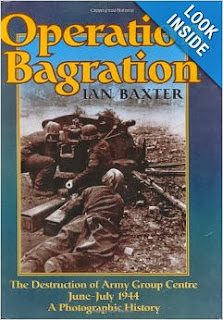
OPERATION BAGRATION: The Destruction of Army Group Centre June-July 1944, A Photographic History
The Soviets punched massive holes in the disintegrating defenses almost everywhere, letting through a seemingly-unstoppable flood, pushing apart and encircling many precious German Panzer and infantry divisions. In the end Bagration cost the Wehrmacht more men and material than the catastrophe at Stalingrad sixteen months earlier. The shattering defeat of Army Group Centre resulted in the loss of over 300,000 men and witnessed Soviet forces pushing exhausted German remnants out of Russia and through Poland to the gates of Warsaw.

Share this PostPin ThisShare on TumblrShare on Google PlusEmail This

Where did The Germans Go Wrong In Russia?

“Many of our leaders greatly underestimated the new enemy. This happened partly because they knew nothing either of the Russian people, or even the Russian soldiers. Some of our commanders were always on the Western Front during World War I, and never fought in the East, so they had no idea about the geographical features of Russia and the persistence of the Russian army. At the same time they ignored the repeated warnings of prominent military experts on Russia… 
The behavior of Russian troops, even in this first battle (for Minsk), is strikingly different from that of the Poles and the troops of the Western Allies in defeat. Even being surrounded, the Russians did not depart from their borders.” 
General Günther Blumentritt


Hitler always thought he knew best. He preferred to appoint toadies and could not stomach the brutal truth that competent and gutsy generals in the Wehrmacht told him. Guderian was a good example.. 

If only had Hitler listened to his good generals more, the outcome of the Second World War would have been different.

Hitler said before Barbarossa "You only have to kick in the door and the whole rotten structure will come crashing down."

He was wrong.

Below General Guenther Blumentritt gives an analysis of what war in Russia meant. It is adapted from THE FATAL DECISIONS: Six Decisive Battles of the Second World War from the Viewpoint of the Vanquished by William Richardson and Seymour Freidlin

Russia and Russian. An estimate of the enemy should be approached very cautiously. It is better to overestimate them than underestimate. It is necessary to assume that the enemy can actually be much stronger than we imagine. Failure to properly assess the enemy can lead to unpleasant surprises. The Oriental is much different from Westerners. . His lifestyle is very simple, even primitive compared to our standards. Easterners attach little importance to what they eat and what they wear. It's amazing how long they can live on which for a European would mean starvation. A Russian is close to nature. Heat and cold have almost no effect on him. In winter, he protects himself from severe cold with  anything that comes his way.
--------------------------------
“The Russian remains a good soldier everywhere and in all circumstances…Field kitchen, almost sacred in the eyes of the soldiers of other armies, is just a pleasant surprise for the Russians, and they can spend days and weeks without it. The Russian soldier is completely satisfied with a handful of millet or rice adding to it what nature gives him. The soldier of the Russian army is an unsurpassed master of disguise, self-entrenching and field fortifications… The strength of the Russian soldier is due to his extreme closeness to nature. For him, there are simply no natural barriers: in heavy forest, swamps and marshes, in road less steppe – he feels like home everywhere. He crosses a wide river using the most elementary improvised means and can pave a road everywhere. It takes few days for the Russians to build a many-kilometer causeway through an impassable swamp.”
Major-General von Mellenthin 


“Russian troops have always fought bravely and sometimes made incredible sacrifices.”
 Field Marshal Erich von Manstein 

“The Russians held themselves with unexpected firmness and perseverance, even when they were bypassed and surrounded. In this way they won more time and drew up more and more new reserves for the counter-attacks from the depths of the country, which by the way were stronger than anticipated… The enemy has shown an absolutely incredible ability to resist.” 
General Kurt von Tippelskirch 

------------------------------------
 He is a master of imagination. To warm up, he does not need complex equipment. Strong and healthy Russian women work the same way as men. Close contact with nature allows a Russian to move freely at night in the fog, through forests and swamps. They are not afraid of the dark, of endless forests and cold. They are no stranger to winter, when the temperature drops to minus 45o C. A Siberian, who can partially or completely be considered Asian, has more endurance, is stronger and has a much greater resistance than a European national. We had already experienced this during the First World War, when we had to deal with the Siberian Army Corps. For Europeans from the West, who are used to small areas, the distances in the East seem endless.


An U.S. citizen is accustomed to think in terms of huge steppes and prairies, and thus he does not share that feeling which is close to horror. The horror is a aggravated melancholy, caused by the monotonous character of the Russian landscape, which is depressing, and especially the gloomy autumn and painfully long winter. The psychological impact of that country on the average German soldier was very strong. He felt worthless, lost in these vast expanses. The natives of East Germany find it much easier to acclimatize in this strange new world, as East Germany is geographically a link between Russia and the West.

Soldiers from other German states, as well as their fathers in World War I, too, had learned to adapt to local conditions. Russia was a true test for our troops. It was a hard school. The man who survived after a meeting with Russian soldiers and Russian climate, knows what war is. All wars waged by Russia, were brutal and bloody. During the Seven Years War, Frederick the Great learned to respect the fighting qualities of the Russian soldier. Napoleon considered the Battle of Borodino as the bloodiest of all battles.

---------------------------
“When I remember that Frederick the Great confronted the enemy possessing the twelvefold superiority in strength, I seem just a simpleton to myself. At this time we do have the superiority in strength! Is not that a shame?”
Hitler (recorded on 28.1 1942) 

---------------------------

The Russian-Turkish war of 1877-1878 was as brutal as the Russian-Japanese war in the early twentieth century. In these two wars losses were enormous. During the First World War, we got to know the Russian Imperial Army. I will give a little-known but significant fact: Our losses on the Eastern Front were much more than the losses incurred by us on the Western Front from 1914 to 1918. Russian generals then were qualitatively inferior to their German counterparts, and the tactics of huge armies in the attack was inflexible.

In the end the humble "subhuman" Ivan proved more than a match for the Fritz
But in defense the Russian army showed remarkable durability. It expertly and quickly built fortifications and equipped the defenses. Their soldiers showed great ability to fight at night and in the woods. Russian soldiers prefer melee. His physical needs are small, but the ability, without flinching, to bear hardship is a true surprise. Such is the Russian soldier, about whom we learned and who imbued us with respect a quarter-century ago.
------------------------------
“Widely and skillfully conceived operations of the Red Army led to numerous encirclements of the German units and destruction of those who resisted.”
General Otto von Lasch 
------------------------------


Since then, the Bolsheviks had systematically re-educated the youth of the country. And it would be logical to assume that the Red Army was a tougher nut to crack than the imperial army. The Russians carefully studied the previous campaigns, and we expect their senior commanders learned from past experience.
---------------------------
“Their commanders instantly learned the lessons of the first defeats and in a short time began to operate surprisingly effectively.”
 Field Marshal General Georg von Kleist 

The difference between the Russian Imperial Army during World War I and the Red Army in the days of the German invasion was simply colossal. During the last war the Russian army was more like an amorphous mass, physical inactive and devoid of individuality. This time, the spiritual uplift caused by the ideas of communism already started to affect them in the summer of 1941.”
General Eric Rouse 
--------------------------

 But the middle and junior commanders, according to our observers, were poorly trained and had no combat experience. It was very difficult to get a clear idea of equipment of the Red Army. The Russians take thorough and effective security measures. Hitler refused to believe that the Soviet industrial production could be equal to that of Germany. We had little information about the Russian tanks. We had no idea of how many tanks a month the Russian industry could churn out. It was hard to get even a card, as the Russian held them in great secrecy. The cards at our disposal were often incorrect and misleading. About the combat power of the Russian army also, we did not have accurate data. Those of us who fought in Russia during the First World War, believed that it is large, and those who did not know the new enemy, were inclined to underestimate her. How should we react to the civilian population of Russia, we did not know. In 1914-1918 the Russian population treated us gently and loyally. No one could say how much that had changed over the years.

-------------------------------------
From Spartacus

It was appallingly difficult country for tank movement - great virgin forests, widespread swamps, terrible roads, and bridges not strong enough to bear the weight of tanks. The resistance also became stiffer, and the Russians began to cover their front with minefields. It was easier for them to block the way because there were so few roads.

The great motor highway leading from the frontier to Moscow was unfinished - the one road a Westerner would call a 'road'. We were not prepared for what we found because our maps in no way corresponded to reality. On those maps all supposed main roads were marked in red, and there seemed to be many, but they often proved to be merely sandy tracks. The German intelligence service was fairly accurate about conditions in Russian-occupied Poland, but badly at fault about those beyond the original Russian frontier.

Such country was bad enough for the tanks, but worse still for the transport accompanying them - carrying their fuel, their supplies, and all the auxiliary troops they needed. Nearly all this transport consisted of wheeled vehicles, which could not move off the roads, nor move on if the sand turned into mud. An hour or two of rain reduced the panzer forces to stagnation. It was an extraordinary sight, with groups of them strung out over a hundred miles stretch, all stuck - until the sun came out and the ground dried. Hoth, who was advancing from the Orsha-Nevel sector, was delayed by swamps as well as bursts of rain. Guderian made a rapid advance to Smolensk, but then met similar trouble.


A number of the generals declared that a resumption of the offensive in 1942 was impossible, and that it was wiser to make sure of holding what had been gained. Halder was very dubious about the continuance of the offensive. Von Rundstedt was still more emphatic and even urged that me German Army should withdraw to their original front in Poland. Von Leeb agreed with him. While other generals did not go so far as this, most of them were very worried as to where the campaign would lead. With the departure of von Rundstedt as well as von Brauchitsch, the resistance to Hitler's pressure was weakening and that pressure was all for resuming the offensive.

There was a "battle of opinion" between Halder and him. The Intelligence had information that 600 to 700 tanks a month were coming out of the Russian factories, in the Ural Mountains and elsewhere. When Halder told him of this. Hitler slammed the table and said it was impossible. He would not believe what he did not want to believe.

Secondly, he did not know what else to do-as he would not listen to any idea of a withdrawal. He felt that he must do something and that something could only be offensive.

Thirdly, there was much pressure from economic authorities in Germany. They urged that it was essential to continue the advance, telling Hitler that they could not continue the war without oil from the Caucasus and wheat from the Ukraine.

Share this PostPin ThisShare on TumblrShare on Google PlusEmail This

German Soldiers In Russia

 German soldiers in Kharkov. 1942

 German troops in the Ukrainian town of Alexandria
 Alexandria again

 The French did not like it then and they do not like it even today. The fact that many Frenchmen fought in the Wehrmacht. This man is from the French Legion in Russia. 1941.

Incidentally the French soldiers in the German army during WW2 proved to be some of the best fighters in the war. As the Russians closed in on Berlin in April 1945, the last and most tenacious resistance was put up BY FRENCH SOLDIERS IN THE SS

A Frenchman again in the Wehrmacht. Russia 1941

 A French Legion soldier. November 1941. USSR

 More French Legion soldiers

 German soldiers firing at Russians. Summer 1944

 June 1943. Eastern Front

Wehrmacht infantrymen. 1943. Russia


 The man looks very hassled. The Russian rain and the following slush took the goat of most German soldiers
 This pic is from Stalingrad
 Stalingrad again

November 1942. Stalingrad. Things were not very bad then. Hence the smile on his face.


 Early days of Barbarossa. 1941. Germans move into Russia
 Germans talk with a captured Russian soldier
 These men have found Russian girlfriends!

These German soldiers prepare for an attack. Stalingrad. 1942

 Stalingrad again
 Helping an injured comrade


 Summer 1941. Eastern Front

 German soldiers scour a Russian village

Men of the Grossdeutschland Division . Eastern front.


WHAT WAS THE GROSSDEUTSCHLAND DIVISION?


The Großdeutschland Division was a Heer combat unit of the Wehrmacht often portrayed by the Nazi press and media during World War II. For this reason the Großdeutschland was one of best-equipped unit of the German Armed Forces, receiving equipment before all other units.
More on Wikipedia


 December 1941. A German tank trundles through a Russian village near Moscow. The Germans never reached Moscow. Their supply lines were too stretched. The harsh Russian winter struck the ill-prepared German army. And the Russians counter-attacked hard.
 Germans with captured Russian partisans
 Mail from home!
 This German patrol stumbles upon a Soviet partisan camp
A German handles a captured Russian Maxim anti-aircarft gun

This German soldier has his meal

 1941. Eastern Front. German soldiers dig a foxhole

 Stalingrad

This is near Moscow. 1941. Germans chat with captured Russian soldiers

 Grim fighting in Stalingrad. Autumn 1942

 Having a drink

 Germans fire away at Russians. March 1944
 On the way to Moscow. 638th regiment. 7th Division. French Legion
 Fighting in Narva. 1941
 8.8 cm self propelled artillery unit (SAU) PaK 43/1 Pzkpfw 4
 Pzkpfw 3
 Ready for a Russian assault

 Stalingrad. November 1942
Fighting on street of Zhimotir. Summer 1941

More On German Soldiers In Russia

Share this PostPin ThisShare on TumblrShare on Google PlusEmail This

You Might Like These....

Search This Site

Popular Articles On This Site

More History Sites

Illustrated History

A Lousy Journalist?

A Lousy Journalist?
"Those who do not remember the past are condemned to repeat it."
-- George Santayana


History Quotes

May 1945 - If hell on earth existed, than it existed in Prague after May the 5th. 1945. Old men, women and children were beaten to death and maimed. Rapes, barbaric cruelties, horror-scenarios of hellish proportions - here they had been let lose.

- Ludek Pachmann, Czech Chess-Grand Master and publicist, forty years after the fact.

Copyright Issue

All the images on this site have been uploaded from the internet. Their copyrights lie with the respective owners.

If inadvertently any copy-righted material is published on this site, the owners of the material may contact us at balri24@gmail.com. We will remove the relevant portion immediately

Quotes

"History is a guide to navigation in perilous times. History is who we are and why we are the way we are."
-- DAVID C. MCCULLOUGH

History, despite its wrenching pain, cannot be unlived, but if faced with courage, need not be lived again.
-- MARY ANGELOU

Quotes

HISTORY, n. An account mostly false, of events mostly unimportant, which are brought about by rulers mostly knaves, and soldiers mostly fools.
-- Ambrose Bierce

We learn from history that we learn nothing from history.
-- GEORGE BERNARD SHAW

Quotes

"I have but one lamp by which my feet are guided, and that is the lamp of experience. I know no way of judging of the future but by the past."
--EDWARD GIBBON

"Patriotism ruins history."
-- GOETHE

Snippets from History

This short but important battle played a key role in the decision to use atomic bombs when attacking Hiroshima and Nagasaki. The battle showed just how far Japanese troops would go to defend their country.


Snippets From History

Paulus didn't give the order to 6th Army to surrender, but his troops no longer had much fight left in them. Resistance faded out over the next two days, with the last die-hards finally calling it quits. One Red Army colonel shouted at a group of prisoners, waving at the ruins all around them: "That's how Berlin is going to look!
"


Quotes

History is Philosophy teaching by examples.
-- THUCYDIDES

Quotes

"Those who cannot learn from history are doomed to repeat it."
-- George Santayana

Points to Ponder: Why Is China Unstable?

The aim of individuals in any society is money and power. Societies that give equal chance to all its members to get them will be the most stable. That is why democracies are more stable than other systems of governance.

China after Deng's reform gave the chance to get rich but power is in the hands of an elite; the Communist Party of China. Membership to the party is at the whims of the local party bosses. This leaves out many people who crave political power dissatisfied and disgruntled. There in lies the roots of instability. The Party suppressed these demands once at Tiananmen in 1989. But force is hardly the way to deal with things like these.

READ MORE: Tiananmen Square Massacre